
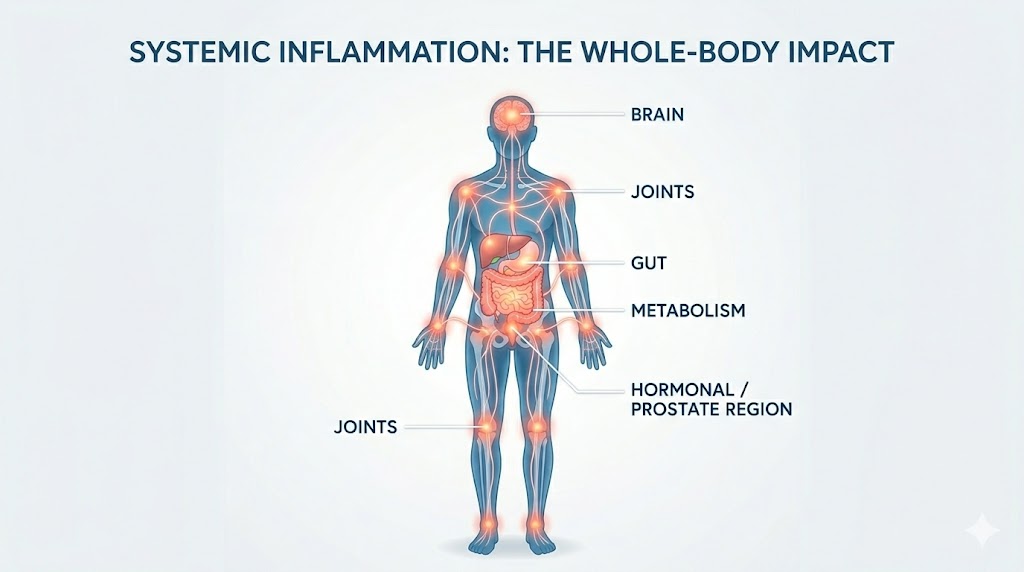
Inflammation is often discussed as if it’s localized — a sore joint, an irritated gut, or inflamed tissue.
In reality, chronic inflammation is systemic.
Once inflammatory signaling becomes persistent, it spreads through the bloodstream and nervous system, affecting multiple organs at the same time. This is why symptoms often appear unrelated — yet worsen together.
Chronic inflammation acts less like a fire in one room and more like smoke filling the entire building.
Why Inflammation Never Stays in One Place
When inflammation becomes chronic:
- Immune signals circulate continuously
- Hormones become resistant or suppressed
- Blood sugar regulation weakens
- The nervous system stays in alert mode
- Tissue repair slows
Over time, this creates cross-system dysfunction — where problems in one area amplify problems in another.
🦴 Joints & Muscles
Chronic inflammation increases the breakdown of connective tissue and reduces recovery capacity.
Common effects include:
- Morning stiffness
- Lingering aches without injury
- Reduced flexibility
- Accelerated joint degeneration
👉 Explore deeper: https://thehealthknowledgebase.com/inflammation/joint-muscle/
⚡ Metabolism & Weight Regulation
Inflammation interferes with insulin signaling and fat metabolism.
This often leads to:
- Blood sugar spikes
- Energy crashes after meals
- Fat storage (especially abdominal fat)
- Resistance to weight loss despite effort
👉 Explore deeper: https://thehealthknowledgebase.com/inflammation/metabolic/
🧠 Brain & Nervous System
Inflammatory molecules can cross the blood–brain barrier, triggering neuroinflammation.
This affects:
- Focus and memory
- Mood stability
- Stress tolerance
- Sleep quality
Symptoms often include brain fog, anxiety, low motivation, and poor sleep.
👉 Explore deeper: https://thehealthknowledgebase.com/inflammation/brain/
🦠 Gut & Immune System
The gut is both a source and target of inflammation.
Chronic inflammation can:
- Weaken the gut barrier
- Increase food sensitivities
- Overload the immune system
- Promote systemic inflammatory spread
Digestive symptoms often coexist with joint pain, fatigue, and mood changes.
👉 Explore deeper: https://thehealthknowledgebase.com/inflammation/gut/
🧬 Hormones & Prostate Health
Inflammation disrupts hormone signaling and receptor sensitivity.
This can result in:
- Cortisol dysregulation
- Testosterone suppression
- Estrogen imbalance
- Worsening urinary symptoms
Hormonal inflammation is frequently overlooked but plays a major role in aging-related decline.
👉 Explore deeper: https://thehealthknowledgebase.com/inflammation/hormonal/
The Inflammatory Cascade (Why Symptoms Multiply)
Once chronic inflammation is established:
- Blood sugar instability fuels inflammation
- Inflammation disrupts hormones
- Hormonal imbalance worsens stress response
- Stress further inflames the nervous system
- Gut integrity weakens
- Inflammation spreads system-wide
This feedback loop explains why single-symptom treatments often fail.
Why Treating One Area Isn’t Enough
Targeting inflammation in one system while ignoring others is like patching one leak in a flooded house.
True recovery requires:
- Nervous system regulation
- Metabolic stabilization
- Gut repair
- Hormonal balance
- Reduced inflammatory load
This is why system-level approaches work where isolated fixes don’t.
❓ FAQs: How Inflammation Affects the Body
1. Can inflammation affect multiple organs at once?
Yes. Chronic inflammation is systemic by nature.
2. Why do symptoms seem unrelated?
Because different systems express inflammation differently.
3. Does inflammation always cause pain?
No. Fatigue, brain fog, and metabolic issues often appear first.
4. Can inflammation cause weight gain?
Yes, through insulin resistance and hormonal disruption.
5. Is brain inflammation reversible?
Often, yes — when root causes are addressed.
6. Why does gut health affect the whole body?
Because the gut regulates immune signaling and inflammation.
7. Does stress really increase inflammation?
Yes. Chronic stress is one of the strongest inflammatory drivers.
8. Can inflammation worsen with age?
Yes, especially when metabolism and hormones decline.
9. Are medications enough to control inflammation?
They manage symptoms but rarely address root causes.
10. What’s the best first step to reduce inflammation?
Stabilizing blood sugar and nervous system signaling.
Inflammation Is a Whole-Body Issue
Explore how inflammation affects specific systems and learn targeted, natural strategies to reduce it at the root.
Inflammation Impacts More Than One System
If inflammation is affecting your joints, metabolism, brain, gut, or hormones, the issue is rarely isolated. Chronic inflammation is a whole-body process — and it requires a whole-body approach.
Visit the full hub to explore root causes, system-specific guides, and natural strategies to reduce inflammation at its source.
Explore the Inflammation & Chronic Disease Health Hub →Start with the Complete Guide to Chronic Inflammation to understand how systemic inflammation develops and how to reverse it naturally.

Medically Reviewed for Accuracy
This content has been reviewed for accuracy and clarity by The Health Knowledge Base Medical Review Team, using current research and evidence-based health guidance.
Our review process helps ensure that information related to health, wellness, nutrition, lifestyle strategies, and natural support topics reflects current scientific understanding and responsible editorial standards.
Written by The Health Knowledge Base Editorial Team
Our editorial team consists of health researchers, wellness writers, and content specialists focused on creating clear, practical, and research-informed health content.
We publish educational articles designed to help readers better understand health topics, explore natural wellness strategies, and make more informed lifestyle decisions with confidence.