Stay Informed With Trusted Health Insights
Join 5,000+ readers who receive evidence-informed health articles, wellness tips, supplement reviews, and practical health guides delivered straight to their inbox.
Get Free Health UpdatesNo spam. Just helpful health education, updates, and resources.
If you’ve ever wondered why your energy, metabolism, or mood can shift so quickly — the answer might lie in two tiny but powerful hormones: T3 and T4.
These thyroid hormones are the spark plugs of your body.
They keep every cell energized, regulate temperature, influence heart rate, and even affect how your brain feels and functions.
And for women, the delicate balance between T3 (Triiodothyronine) and T4 (Thyroxine) can make all the difference between feeling vibrant or completely worn out.
💡 To understand the gland behind these hormones, start with What the Thyroid Gland Really Does (and Why It’s So Important for Women).
🩺 T3 and T4 — The Power Duo That Runs Your Metabolism
Your thyroid gland produces two primary hormones:
- T4 (Thyroxine) — makes up about 80% of what the thyroid releases. It’s mostly inactive, acting as a storage form of thyroid energy.
- T3 (Triiodothyronine) — the active form of thyroid hormone that actually fuels metabolism, brain function, and energy.
Here’s the key:
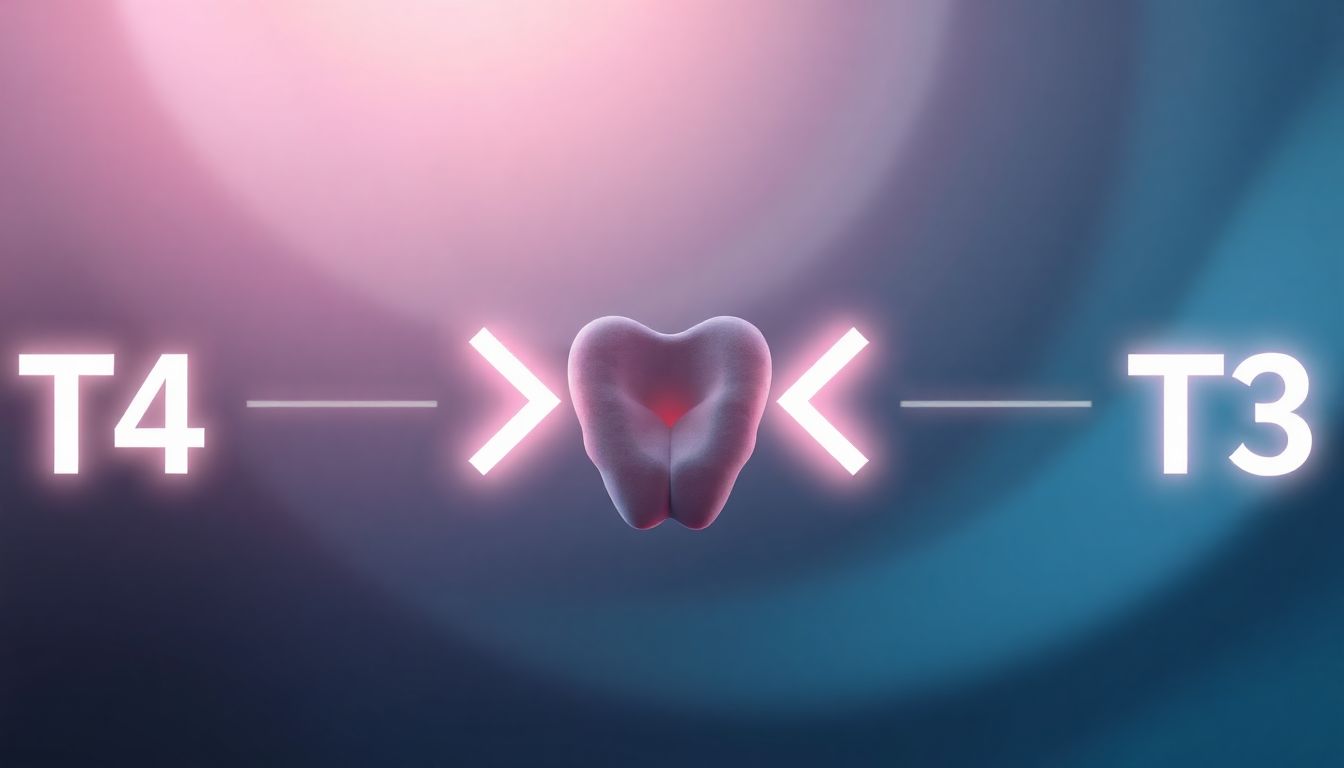
Your body must convert T4 into T3 for your thyroid to function properly.
If that conversion process slows — due to stress, nutrient deficiencies, or aging — your metabolism, focus, and energy all drop.
🔄 Learn how to boost this conversion naturally in 10 Essential Vitamins and Minerals for a Healthy Thyroid.
⚙️ How T3 and T4 Work Together
Imagine T4 as a “battery pack” and T3 as the “electricity.”
When your thyroid produces enough T4, your body can activate it into T3 as needed.
Here’s how the process works:
1️⃣ The Brain Sends the Signal — Your pituitary gland releases TSH (Thyroid-Stimulating Hormone) to trigger thyroid hormone production.
2️⃣ Thyroid Releases T4 and T3 — Mostly T4, with a little T3.
3️⃣ Conversion Happens in the Liver and Gut — Selenium, zinc, and magnesium help transform T4 into active T3.
4️⃣ T3 Enters Cells — It switches on energy production and metabolism.
When this cycle is smooth, you feel energetic, clear-headed, and emotionally balanced.
When it’s disrupted, you may experience fatigue, weight gain, or mood changes.
🌿 See how stress can disrupt this conversion in How Stress Impacts Your Thyroid (and Natural Ways to Restore Balance).
🌸 Why This Balance Matters More for Women
Women’s hormones — estrogen, progesterone, and cortisol — directly influence how efficiently the thyroid produces and converts T4 into T3.
That’s why many women start noticing thyroid symptoms around:
- Perimenopause or menopause
- Postpartum recovery
- Times of chronic stress
When estrogen fluctuates, it can bind to thyroid-binding proteins, leaving less free T3 available.
Meanwhile, high cortisol levels from stress can block the T4→T3 conversion completely.
Result: Slower metabolism, mood swings, and hormonal imbalance.
💬 Learn how this interplay affects emotions in The Link Between Thyroid and Mood Swings or Anxiety.
🔬 The Science: What Research Says About T3 & T4
- Low T3 is often linked to chronic fatigue, depression, and brain fog.
- Excess T4 without proper conversion can make you anxious or restless.
- Optimal thyroid health depends on balanced conversion — not just hormone production.
A 2019 Endocrine Reviews study found that even when total T4 levels are normal, low T3 levels predict fatigue, metabolic slowdown, and reduced quality of life — especially in women.
🌿 How to Naturally Support T3 and T4 Balance
You can boost thyroid hormone conversion and balance through three key areas:
🧘♀️ 1. Manage Stress
High cortisol blocks conversion. Practice deep breathing, light yoga, or 10-minute mindfulness breaks daily.
💆♀️ Read: How Stress Impacts Your Thyroid (and Natural Ways to Restore Balance).
🍎 2. Eat Nutrient-Rich Foods
Your thyroid needs raw materials to build hormones. Focus on:
- Selenium (Brazil nuts, fish)
- Zinc (pumpkin seeds, lentils)
- Iodine (seaweed, eggs)
- Magnesium (leafy greens)
🥦 Try our nutrition guide: The Best Thyroid-Friendly Diet for Women.
💊 3. Consider Targeted Supplements
Formulas like Thyrafemme provide the ideal blend of iodine, selenium, zinc, and adaptogens like Ashwagandha and Schisandra — all shown to help your body naturally balance T3 and T4 levels.
🌺 Read the science-based breakdown in Does Thyrafemme Really Work? (What Science Says).
💖 Signs Your T3 and T4 May Be Out of Balance
- Constant fatigue or low energy
- Sudden weight gain or loss
- Feeling cold even in warm weather
- Anxiety, irritability, or depression
- Dry skin and hair thinning
- Irregular menstrual cycles
If you’re experiencing several of these, it may be time to check your thyroid levels through a simple blood test — including T3, T4, and TSH.
🧠 Explore common patterns in Signs of an Underactive Thyroid and Signs of an Overactive Thyroid.
🌙 Final Thoughts
T3 and T4 may be tiny molecules, but they shape everything from your metabolism to your mood.
When they’re balanced, you feel sharp, strong, and emotionally steady.
When they’re off — everything feels harder.
The good news?
Through nutrition, stress reduction, and natural support like Thyrafemme, you can help your body restore that balance gently and naturally.
💕 Your thyroid is resilient — it just needs the right support to thrive.
❓ FAQ
1️⃣ What are T3 and T4 hormones?
T3 (Triiodothyronine) and T4 (Thyroxine) are thyroid hormones that control energy, metabolism, and cell activity.
2️⃣ Which is more active — T3 or T4?
T3 is the active form that powers metabolism; T4 is the inactive storage form converted into T3.
3️⃣ How does T4 convert into T3?
Through enzymes supported by minerals like selenium and zinc — mainly in the liver and gut.
4️⃣ What causes poor T4→T3 conversion?
Stress, low selenium or zinc, poor gut health, or high cortisol.
5️⃣ Why is this important for women?
Hormonal shifts during menopause, pregnancy, or stress can disrupt this conversion and trigger thyroid symptoms.
6️⃣ Can diet help regulate T3 and T4?
Yes — iodine, selenium, and zinc are vital for hormone production and activation.
7️⃣ Does Thyrafemme support T3 and T4 balance?
Yes — it contains the key nutrients and adaptogens that help the body convert and stabilize these hormones naturally.
8️⃣ How long to see improvement in thyroid levels?
Most people notice better energy and focus within 4–8 weeks of consistent nutritional support.
9️⃣ Can I test my T3 and T4 levels?
Yes — ask your doctor for a thyroid panel that includes TSH, Free T3, and Free T4.
🔟 Can stress imbalance T3 and T4?
Absolutely — chronic stress raises cortisol, blocking conversion.

Medically Reviewed for Accuracy
This content has been reviewed for accuracy and clarity by The Health Knowledge Base Medical Review Team, using current research and evidence-based health guidance.
Our review process helps ensure that information related to health, wellness, nutrition, lifestyle strategies, and natural support topics reflects current scientific understanding and responsible editorial standards.
Written by The Health Knowledge Base Editorial Team
Our editorial team consists of health researchers, wellness writers, and content specialists focused on creating clear, practical, and research-informed health content.
We publish educational articles designed to help readers better understand health topics, explore natural wellness strategies, and make more informed lifestyle decisions with confidence.
Affiliate Transparency, Medical Disclaimer & Safety Notice
At The Health Knowledge Base, we take pride in being a trusted resource and affiliate partner with select, high-quality companies. We choose these partnerships carefully because we genuinely believe their products, services, and educational resources align with the values and mission of our website.
When you purchase through certain links on this site, we may receive a small commission or compensation. This helps support our research, content creation, and ongoing work at no additional cost to you. Your price remains exactly the same.
Medical Disclaimer
The information provided by The Health Knowledge Base is for general informational and educational purposes only and is not a substitute for professional medical advice, diagnosis, or treatment.
Always seek the advice of your physician, doctor, or another qualified healthcare provider with any questions you may have regarding a medical condition, symptoms, treatment options, diet changes, exercise programs, or supplements.
Never disregard professional medical advice or delay in seeking it because of something you have read on this website.
Critical Safety Notice
Before making any changes to your diet, starting a new fitness or wellness routine, or taking any supplements mentioned on this site, you should consult with your doctor, physician, or another qualified healthcare professional. Reliance on any information provided by The Health Knowledge Base is solely at your own risk.
View our Affiliate Disclosure → | View our Medical Disclaimer →