Stay Informed With Trusted Health Insights
Join 5,000+ readers who receive evidence-informed health articles, wellness tips, supplement reviews, and practical health guides delivered straight to their inbox.
Get Free Health UpdatesNo spam. Just helpful health education, updates, and resources.
The Surgical Crossroads: Choosing Between Two Proven Paths
When medications fail and minimally invasive options aren’t suitable, surgery becomes the most effective way to relieve severe BPH symptoms. For decades, Transurethral Resection of the Prostate (TURP) was the unchallenged “gold standard.” Today, GreenLight Laser Surgery stands as its most prominent technological challenger.
This isn’t about “old vs. new”—it’s about finding the right tool for your specific anatomy and health goals. Both procedures are highly effective, but they work differently and come with distinct trade-offs. This detailed comparison will equip you with the knowledge to have a confident, informed discussion with your surgeon.
The Head-to-Head Comparison: TURP vs. GreenLight PVP
| Feature | TURP (Gold Standard) | GreenLight PVP (Laser) |
|---|---|---|
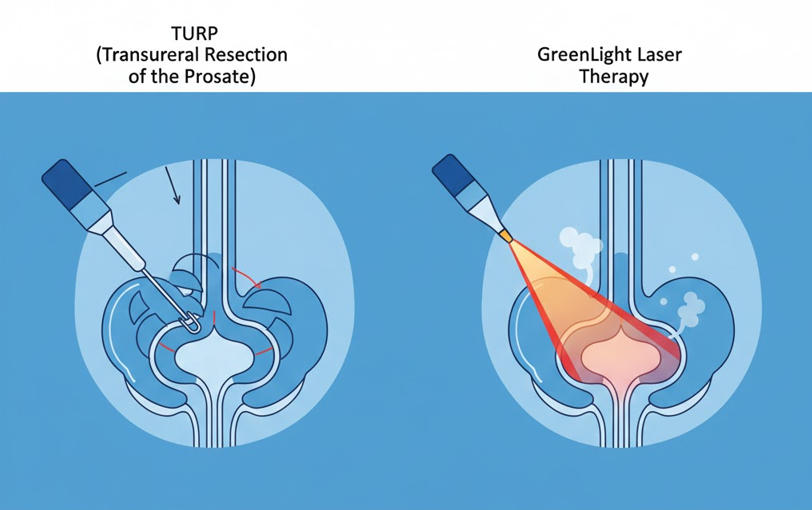
| How It Works | A wire loop (resectoscope) cuts away prostate tissue with electrocautery. | A high-power laser fiber vaporizes (ablates) prostate tissue with extreme heat. |
| Primary Benefit | Maximum Tissue Removal. Provides the most significant and durable improvement in urine flow. | Reduced Bleeding Risk. Laser seals blood vessels as it works, leading to less intraoperative bleeding. |
| Best For | Large prostates, severe obstruction, when maximum tissue removal is the goal. | Patients on blood thinners (with caution), those wanting potentially shorter catheter time. |
| Hospital Stay | 1-3 days (typically 1-2 nights). | Often outpatient or 1-night stay. |
| Catheter Time | 1-3 days post-op. | Often 1-2 days, sometimes less. |
| Key Risks | Bleeding requiring transfusion (1-5%), TUR syndrome (rare, from fluid absorption). | Dysuria (painful urination) can be more pronounced. Re-treatment rate may be slightly higher for very large glands. |
| Sexual Side Effects | Retrograde ejaculation is very common (~75%). Risk of erectile dysfunction (5-10%). | Similar rates of retrograde ejaculation. Slightly lower risk of ED. |
| Long-Term Efficacy | Exceptionally durable. The benchmark for long-term success (10+ years). | Very effective, but may have a slightly higher re-operation rate over 5-10 years for large prostates. |
Diving Deeper: Understanding Each Procedure
Transurethral Resection of the Prostate (TURP): The Proven Workhorse
- The Process: Under spinal or general anesthesia, the surgeon inserts a resectoscope through the penis. A thin wire loop, heated by electrical current, is used to shave away the inner prostate tissue piece by piece. The chips are flushed into the bladder and removed.
- The Big Advantage: Completeness. Surgeons can meticulously sculpt the prostate channel, removing obstructive tissue with great precision. It often provides the single greatest improvement in flow rate.
- The Main Trade-off: Bleeding. Because it cuts tissue, there is more bleeding. This can limit its use in men on certain blood thinners and carries a small risk of needing a blood transfusion.
GreenLight Laser Photoselective Vaporization (PVP): The High-Tech Contender
- The Process: A laser fiber is passed through a cystoscope. The laser emits green light at a wavelength specifically absorbed by the red pigment in blood and prostate tissue. This causes instant vaporization of the tissue, leaving behind a treated layer that sloughs off over weeks.
- The Big Advantage: Hemostasis. The laser energy seals blood vessels as it vaporizes, resulting in a nearly bloodless field. This is its standout benefit.
- The Main Trade-off: Tissue & Time. Vaporization is slightly less efficient at removing large volumes of tissue compared to TURP’s cutting. For very large prostates (>80-100g), the procedure time can be long, and a HoLEP (another laser surgery) might be a better laser option.
Key Decision Factors: What Should Guide Your Choice?
Discuss these points with your urologist to find your best fit:
- Prostate Size: This is the #1 factor. For medium-sized prostates (30-80g), both are excellent. For very large prostates (>80-100g), TURP or HoLEP (Holmium Laser Enucleation) may be more efficient.
- Use of Blood Thinners: If you cannot easily stop anticoagulants (e.g., Plavix, Warfarin), GreenLight’s sealing ability may offer a safety advantage.
- Surgeon Experience & Volume: The most important variable is your surgeon’s skill and comfort level with the chosen technique. Ask: “Which procedure do you perform most often, and what are your personal outcomes?”
- Your Priority: Durability vs. Quick Recovery: If your top priority is a “one-and-done,” decades-long solution and you have a large prostate, lean TURP. If minimizing bleeding and achieving a slightly quicker initial recovery is paramount, lean GreenLight.
- Cost & Insurance: Both are widely covered by insurance. TURP may have lower device costs, while GreenLight uses a proprietary (and costly) laser fiber. Verify coverage specifics with your provider.
What is Recovery Really Like? A Realistic Timeline
Recovery from both procedures shares similarities, with some nuances.
- Catheter: You will go home with a catheter for 1-3 days. GreenLight may allow for earlier removal.
- Initial Symptoms: Expect burning with urination, urgency, and frequency for 1-4 weeks as the healing channel settles. This can be more pronounced with laser vaporization initially.
- Blood in Urine: Intermittent pink or red urine is normal for 2-6 weeks. It’s usually heaviest after catheter removal and then settles.
- Return to Activity: Light desk work in 1-2 weeks. Strenuous activity, heavy lifting, and sex should be avoided for 4-6 weeks.
- Final Result: While flow improves immediately, it can take 3-6 months for all irritation to fully resolve and for you to experience the final, stable outcome.
For an unfiltered, personal look at this journey, read our exclusive: BPH Surgery Recovery: One Man’s Diary (With Photos).
Conclusion: A Choice Between Two Winners
There is no “loser” in this comparison. TURP remains the benchmark for maximal, durable tissue removal. GreenLight PVP is a technologically advanced, safer-bleeding alternative that is particularly well-suited for medium-sized glands and patients concerned about bleeding risks.
Your Decision Checklist:
- Get an accurate prostate size measurement (via ultrasound or MRI).
- Review your complete medication list with your surgeon.
- Ask your surgeon: “Based on my prostate and health, which do you recommend and why? What are your personal complication rates?”
- Weigh your personal priorities: Ultimate durability vs. bleeding risk profile.
The best choice is the one that aligns with your anatomy and gives you the greatest confidence in your surgical team.
Navigate Our Complete BPH Hub:
- Silo 1: BPH Symptoms & Daily Management
- Silo 2: Medical & Surgical Treatments (You are here)
- Silo 3: Natural Remedies & Lifestyle
- Main Hub: The Complete Guide to BPH & Prostate Health
FAQs
1. Which procedure has a lower risk of erectile dysfunction (ED)?
Both procedures carry a risk of ED (5-15%), with many studies showing no statistically significant difference between modern TURP and GreenLight. The risk is generally lower than many men fear and is often temporary. The risk of retrograde ejaculation, however, is high with both (50-90%).
2. Is GreenLight laser surgery really “bloodless”?
While not completely bloodless, GreenLight causes significantly less bleeding than TURP because the laser energy seals blood vessels as it works. This is its primary advantage, especially for patients with bleeding disorders or on blood thinners.
3. Can TURP or GreenLight be repeated if BPH grows back?
Yes, but it’s more challenging. Scar tissue forms after any prostate surgery, making a second procedure technically more difficult and riskier. This is why choosing the right procedure the first time for maximum, durable tissue removal is emphasized, especially for younger men.
4. I have a very large prostate (over 100 grams). Which is better?
For very large prostates, TURP is often considered more efficient at removing high volumes of tissue in one session. However, the laser enucleation procedure called HoLEP is increasingly considered the superior option for giant prostates, as it can enucleate the entire adenoma like peeling an orange. Discuss all three options (TURP, GreenLight, HoLEP) with your surgeon.
5. How long do the results of each procedure last?
TURP has the longest and most durable track record, with many men enjoying excellent results for 10-15 years or more. GreenLight is also very durable, but some long-term studies suggest a slightly higher rate of needing repeat surgery (re-operation) at the 5-10 year mark compared to TURP.
6. Is the burning during urination worse with GreenLight?
Many patients report that the dysuria (burning/painful urination) in the first 2-4 weeks can be more intense with GreenLight. This is due to the deeper thermal effect of the laser on the surrounding tissue. It is temporary and manageable with medications.
7. Which procedure has a shorter catheter time?
GreenLight often has a slight edge. Catheters may be removed in 24-48 hours in some cases, compared to the more typical 1-3 days for TURP. However, this depends heavily on the surgeon’s protocol and individual patient factors.
8. What is “TUR Syndrome” and does GreenLight avoid it?
TUR Syndrome is a rare but serious complication of TURP caused by absorption of the irrigation fluid into the bloodstream. It can cause electrolyte imbalance. GreenLight uses saline irrigation, which eliminates the risk of TUR Syndrome—a clear safety advantage.
9. Can I choose GreenLight if I want to preserve ejaculation?
No. Both TURP and GreenLight destroy or reshape the bladder neck, which is necessary for antegrade (forward) ejaculation. Retrograde ejaculation is a near-universal outcome with both. If preserving ejaculation is a priority, discuss UroLift or Rezūm.
10. How do I find a surgeon skilled in both techniques?
Ask directly: “How many of each procedure do you perform per year?” A high-volume surgeon is key. You can also seek out a fellowship-trained endourologist (a urologist specializing in minimally invasive and surgical treatments) who is typically proficient in all modern BPH techniques.
Related Articles
- UroLift for BPH: Pros, Cons, and What to Expect: Compare these surgical options with a minimally invasive alternative that preserves ejaculation.
- BPH Surgery Recovery: One Man’s Diary: See a real, visual timeline of what to expect after TURP/laser surgery.
- BPH Medications Guide: When Are Pills Not Enough?: Understand when it’s time to move from medication to discussing procedures.
- Rezūm Water Vapor Therapy: A Steam Alternative: Explore another minimally invasive, heat-based treatment for BPH.
This article is part of our comprehensive guide to prostate health.
For a complete roadmap covering symptoms, all treatment options, lifestyle tips, and patient stories, visit our main resource hub.
Explore The Complete Guide to BPH & Prostate Health →

Medically Reviewed for Accuracy
This content has been reviewed for accuracy and clarity by The Health Knowledge Base Medical Review Team, using current research and evidence-based health guidance.
Our review process helps ensure that information related to health, wellness, nutrition, lifestyle strategies, and natural support topics reflects current scientific understanding and responsible editorial standards.
Written by The Health Knowledge Base Editorial Team
Our editorial team consists of health researchers, wellness writers, and content specialists focused on creating clear, practical, and research-informed health content.
We publish educational articles designed to help readers better understand health topics, explore natural wellness strategies, and make more informed lifestyle decisions with confidence.
Affiliate Transparency, Medical Disclaimer & Safety Notice
At The Health Knowledge Base, we take pride in being a trusted resource and affiliate partner with select, high-quality companies. We choose these partnerships carefully because we genuinely believe their products, services, and educational resources align with the values and mission of our website.
When you purchase through certain links on this site, we may receive a small commission or compensation. This helps support our research, content creation, and ongoing work at no additional cost to you. Your price remains exactly the same.
Medical Disclaimer
The information provided by The Health Knowledge Base is for general informational and educational purposes only and is not a substitute for professional medical advice, diagnosis, or treatment.
Always seek the advice of your physician, doctor, or another qualified healthcare provider with any questions you may have regarding a medical condition, symptoms, treatment options, diet changes, exercise programs, or supplements.
Never disregard professional medical advice or delay in seeking it because of something you have read on this website.
Critical Safety Notice
Before making any changes to your diet, starting a new fitness or wellness routine, or taking any supplements mentioned on this site, you should consult with your doctor, physician, or another qualified healthcare professional. Reliance on any information provided by The Health Knowledge Base is solely at your own risk.
View our Affiliate Disclosure → | View our Medical Disclaimer →