Stay Informed With Trusted Health Insights
Join 5,000+ readers who receive evidence-informed health articles, wellness tips, supplement reviews, and practical health guides delivered straight to their inbox.
Get Free Health UpdatesNo spam. Just helpful health education, updates, and resources.
Why Magnesium Is Central to Muscle and Nerve Pain
Magnesium is one of the most overlooked minerals in chronic pain discussions—yet it plays a critical role in muscle relaxation, nerve signaling, and pain regulation.
Low magnesium status has been linked to:
- Muscle tightness and spasms
- Heightened nerve excitability
- Poor sleep quality
- Increased pain sensitivity
For people with back pain, sciatica, or chronic tension, choosing the right form of magnesium can make a meaningful difference.
This guide explains:
- The most common magnesium types
- How each form affects muscles and nerves
- Which options are best suited for back pain
For a broader supplement overview, see:
Back Pain Supplements: Evidence-Based Support Options
https://thehealthknowledgebase.com/back-pain/best-supplements/
Why Magnesium Deficiency Is Common
Magnesium deficiency is widespread due to:
- Processed food diets
- Chronic stress
- Certain medications
- Poor absorption
Even mild deficiency may contribute to:
- Muscle guarding
- Nerve hypersensitivity
- Poor recovery from physical strain
This is especially relevant for lower back pain sufferers.
Related article:
Magnesium Deficiency and Lower Back Tightness
https://thehealthknowledgebase.com/back-pain/lower-back/magnesium-deficiency/
How Magnesium Supports Muscle and Nerve Function
Magnesium helps by:
- Regulating calcium flow in muscles (relaxation)
- Stabilizing nerve firing
- Supporting energy production
- Reducing stress-related muscle tension
When magnesium levels are low, muscles may stay partially contracted and nerves may fire excessively—both of which worsen pain.
Common Magnesium Types Compared
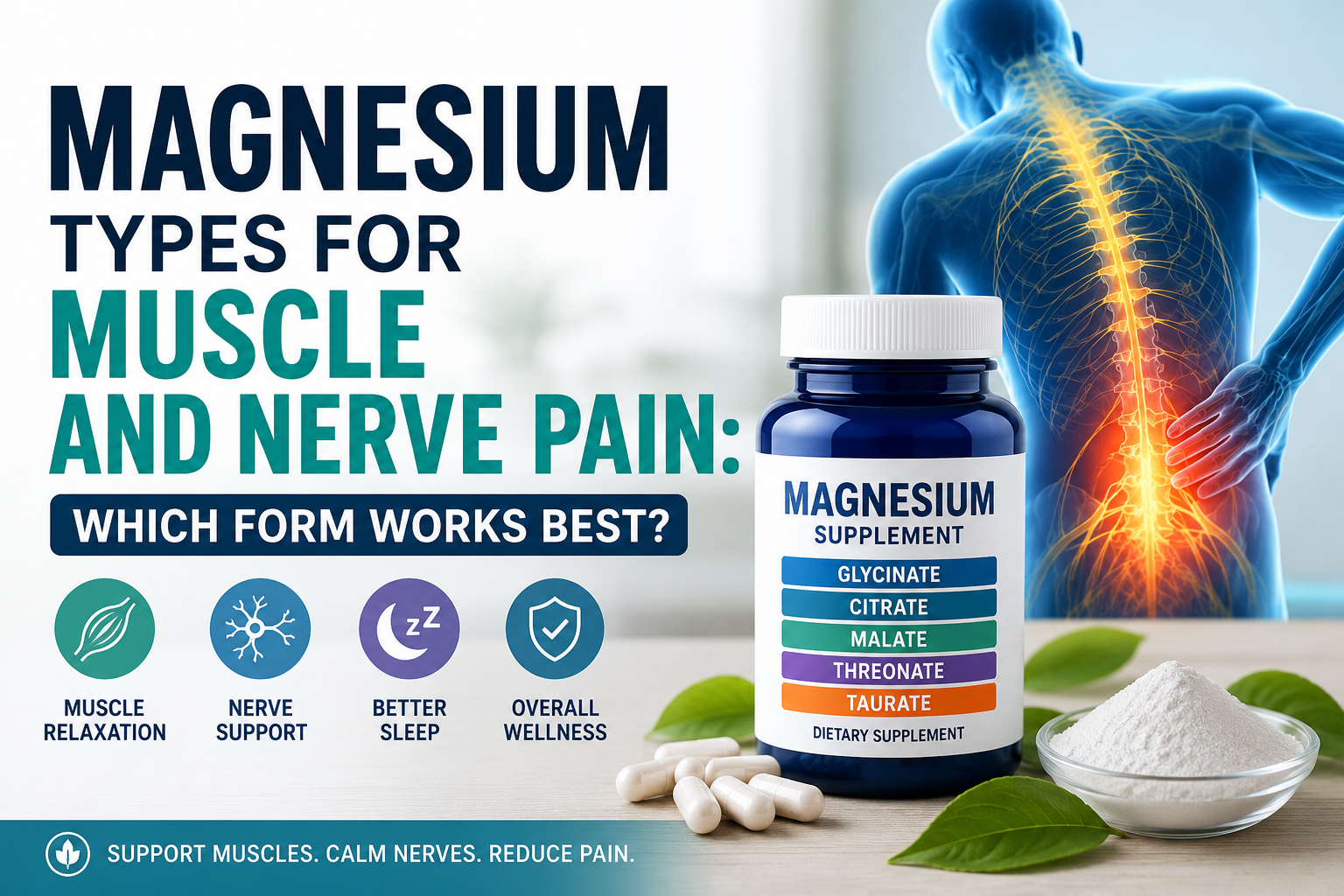
Magnesium Glycinate
Best for: Muscle tension, nerve pain, sleep support
Magnesium glycinate is bound to glycine, an amino acid with calming properties.
Benefits include:
- High absorption
- Gentle on digestion
- Supports muscle relaxation
- May improve sleep quality
This is one of the most commonly recommended forms for chronic back pain and nerve discomfort.
Magnesium Citrate
Best for: General supplementation, constipation-related tension
Magnesium citrate is well absorbed but has a mild laxative effect.
It may help with:
- General magnesium repletion
- Muscle tightness
However, it may cause digestive discomfort in sensitive individuals and is not ideal for long-term high dosing.
Magnesium Malate
Best for: Muscle soreness and fatigue
Malate plays a role in cellular energy production.
This form may be helpful when:
- Muscle pain is accompanied by fatigue
- Pain worsens after physical exertion
It is often discussed in musculoskeletal pain contexts.
Magnesium Threonate
Best for: Neurological support
Magnesium threonate is known for crossing the blood–brain barrier more efficiently.
While not specific to back pain, it may support:
- Central nervous system regulation
- Pain perception modulation
It is more commonly used for cognitive support but may indirectly benefit nerve-related pain.
Magnesium Oxide
Best for: Short-term use only
Magnesium oxide contains a high amount of elemental magnesium but is poorly absorbed.
It is more commonly used for:
- Short-term constipation relief
It is generally not recommended for muscle or nerve pain support.
Which Magnesium Type Is Best for Back Pain?
A simplified guide:
- Muscle tightness & spasms: Magnesium glycinate or malate
- Nerve pain & sleep issues: Magnesium glycinate
- Fatigue-related pain: Magnesium malate
- Digestive sensitivity: Avoid citrate and oxide
Magnesium glycinate is often the most balanced option for chronic back pain sufferers.
Magnesium vs Other Supplement Categories
Magnesium works best when:
- Muscle tension is present
- Pain worsens at night
- Stress contributes to symptoms
If pain is primarily nerve-related, see:
Nerve Pain Supplements Compared
https://thehealthknowledgebase.com/back-pain/best-supplements/nerve-pain/
If pain is joint-related, see:
Joint Support Supplements for Back Pain
https://thehealthknowledgebase.com/back-pain/best-supplements/joint-support/
Safety and Dosage Considerations
General guidelines:
- Start with lower doses
- Split doses if needed
- Avoid excessive intake without guidance
Possible side effects include:
- Loose stools (especially citrate or oxide)
- Drowsiness at higher doses
Those with kidney conditions should consult a healthcare professional before supplementation.
When Magnesium Is Unlikely to Help
Magnesium alone is unlikely to help when:
- Pain is caused by severe structural compression
- Acute injury is present
- Neurological red flags exist
In these cases, medical evaluation is essential.
Explore Back Pain Supplement Strategies
Magnesium is just one piece of the puzzle. Explore related guides to build a complete support strategy.
When Back Pain Won’t Stop, Try This One-Finger Rub Fix…
(Watch Video)

If you have suffered for more than 3 months from chronic lower back pain…
And you are unable to bend, move freely or sleep properly through the night…
And want to finally erase more than 90% of the crippling pain plaguing your back and your body…
Follow this recently discovered one-finger rub fix for one minute a day…it helped over 77,000 people easily fix their back pain, neck pain, arthritis and even hip pain on the spot!
This unique spine, nerves and muscles rejuvenation technique, based on the famous “HEALING MOLECULE” discovered over 60 years ago and later on banned by the FDA…
Is now used successfully by top Olympic weightlifters to quickly recover from injury and skip years of treatment.
The best thing?
It’s completely natural, requires no dangerous drugs or weird stretches and you can do it safely from the comfort of your home starting right now!
Click here to see exactly how easily you can get rid of back pain or any type of pain almost instantly!
Watch Video

Medically Reviewed for Accuracy
This content has been reviewed for accuracy and clarity by The Health Knowledge Base Medical Review Team, using current research and evidence-based health guidance.
Our review process helps ensure that information related to health, wellness, nutrition, lifestyle strategies, and natural support topics reflects current scientific understanding and responsible editorial standards.
Written by The Health Knowledge Base Editorial Team
Our editorial team consists of health researchers, wellness writers, and content specialists focused on creating clear, practical, and research-informed health content.
We publish educational articles designed to help readers better understand health topics, explore natural wellness strategies, and make more informed lifestyle decisions with confidence.
Affiliate Transparency, Medical Disclaimer & Safety Notice
At The Health Knowledge Base, we take pride in being a trusted resource and affiliate partner with select, high-quality companies. We choose these partnerships carefully because we genuinely believe their products, services, and educational resources align with the values and mission of our website.
When you purchase through certain links on this site, we may receive a small commission or compensation. This helps support our research, content creation, and ongoing work at no additional cost to you. Your price remains exactly the same.
Medical Disclaimer
The information provided by The Health Knowledge Base is for general informational and educational purposes only and is not a substitute for professional medical advice, diagnosis, or treatment.
Always seek the advice of your physician, doctor, or another qualified healthcare provider with any questions you may have regarding a medical condition, symptoms, treatment options, diet changes, exercise programs, or supplements.
Never disregard professional medical advice or delay in seeking it because of something you have read on this website.
Critical Safety Notice
Before making any changes to your diet, starting a new fitness or wellness routine, or taking any supplements mentioned on this site, you should consult with your doctor, physician, or another qualified healthcare professional. Reliance on any information provided by The Health Knowledge Base is solely at your own risk.
View our Affiliate Disclosure → | View our Medical Disclaimer →