
Stay Informed With Trusted Health Insights
Join 5,000+ readers who receive evidence-informed health articles, wellness tips, supplement reviews, and practical health guides delivered straight to their inbox.
Get Free Health UpdatesNo spam. Just helpful health education, updates, and resources.
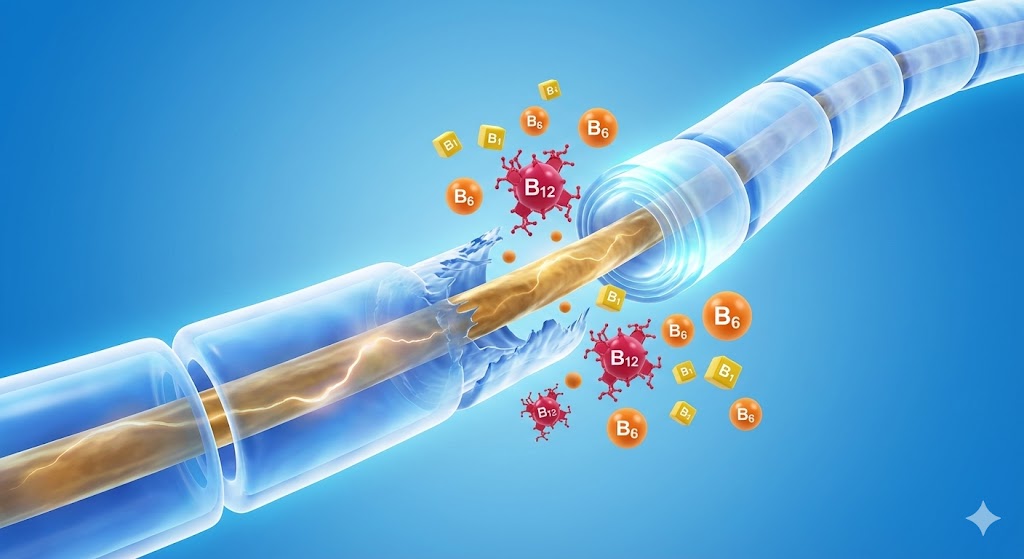
Neuropathy is not always caused by irreversible nerve damage. In many cases, symptoms such as tingling, numbness, burning pain, or loss of sensation are driven by nutritional deficiencies, particularly involving B vitamins.
B vitamins play a central role in:
- Nerve signal transmission
- Myelin sheath maintenance
- Neurotransmitter production
- Cellular energy metabolism
When B vitamin levels are insufficient, nerves become vulnerable to damage, inflammation, and impaired repair.
This guide explains:
- How B vitamins support nerve health
- The specific roles of B1, B6, and B12
- How deficiencies contribute to neuropathy
- Safe and effective supplementation strategies
For a foundational overview, visit the
Nerve Health Hub:
https://thehealthknowledgebase.com/nerve-health/
Why B Vitamins Are So Important for Nerve Health
Peripheral nerves are among the most metabolically active tissues in the body. They rely heavily on B vitamins to:
- Conduct electrical signals efficiently
- Repair damaged myelin
- Produce neurotransmitters
- Convert nutrients into energy
Without adequate B vitamin support, nerve signaling slows, structural integrity declines, and symptoms of neuropathy emerge.
Vitamin-related neuropathy is especially common in:
- Adults over 40
- People with diabetes or insulin resistance
- Individuals with digestive or absorption disorders
- Long-term users of certain medications
Many of these cases improve when deficiencies are identified and corrected early.
How B Vitamin Deficiencies Cause Neuropathy
B vitamin deficiency–related neuropathy develops through several mechanisms:
- Reduced myelin formation, slowing nerve signals
- Impaired neurotransmitter synthesis, disrupting communication
- Mitochondrial dysfunction, starving nerves of energy
- Increased oxidative stress, damaging nerve fibers
These mechanisms overlap with those seen in peripheral neuropathy, explained in detail here:
https://thehealthknowledgebase.com/nerve-health/peripheral-neuropathy/
Vitamin B1 (Thiamine & Benfotiamine)
Primary Role
Glucose metabolism and energy production in nerve cells
Vitamin B1 enables nerves to convert glucose into usable energy. When B1 is deficient, excess glucose damages nerve tissue—a key mechanism in diabetic neuropathy.
Why Benfotiamine Matters
Benfotiamine is a fat-soluble form of vitamin B1 that:
- Is absorbed more efficiently
- Penetrates nerve tissue better
- Provides stronger protection against sugar-related nerve damage
This makes it particularly valuable for blood-sugar-related nerve issues.
Related reading:
https://thehealthknowledgebase.com/nerve-health/diabetic-neuropathy/
Vitamin B6 (Pyridoxine – Balance Is Critical)
Primary Role
Neurotransmitter synthesis and nerve signaling balance
Vitamin B6 is required for the production of:
- Serotonin
- Dopamine
- GABA
These neurotransmitters regulate nerve signaling, pain perception, and nerve excitability.
Important Safety Note
While B6 is essential, excessive long-term intake can cause nerve irritation. This paradox makes proper dosing critical.
B6 works best:
- In moderate amounts
- In combination with B1 and B12
- As part of a balanced nerve formula
Vitamin B12 (Methylcobalamin)
Primary Role
Myelin repair and nerve regeneration
Vitamin B12 is the most critical B vitamin for nerve health. It supports:
- Myelin sheath repair
- Axonal regeneration
- Normal nerve conduction velocity
Signs of B12 Deficiency
- Numbness or tingling in hands and feet
- Burning or electric nerve pain
- Balance problems
- Cognitive changes
Why Form Matters
Methylcobalamin is the bioactive form directly used by nerve tissue. Other forms must be converted, which becomes less efficient with age.
Vitamin B12 deficiency-related neuropathy is often partially or fully reversible if addressed early.
Should B Vitamins Be Taken Together?
In most neuropathy cases, yes.
B vitamins work synergistically, and deficiencies often coexist. Combined formulations:
- Improve nerve repair efficiency
- Reduce the risk of imbalances
- Simplify dosing and compliance
This is why many people choose comprehensive formulations reviewed in the
Best Nerve Supplements pillar:
https://thehealthknowledgebase.com/nerve-health/nerve-supplements/
B Vitamins vs Other Nerve Supplements
B vitamins address foundational nerve requirements, while other compounds provide additional support:
- Alpha-lipoic acid → antioxidant and metabolic protection
https://thehealthknowledgebase.com/nerve-health/nerve-supplements/alpha-lipoic-acid/ - Magnesium → nerve relaxation and excitability control
https://thehealthknowledgebase.com/nerve-health/nerve-supplements/magnesium-for-nerve-pain/ - Acetyl-L-carnitine → mitochondrial energy and regeneration
https://thehealthknowledgebase.com/nerve-health/nerve-supplements/acetyl-l-carnitine/
Together, these form a comprehensive nerve-support strategy.
How Long Do B Vitamins Take to Improve Neuropathy?
General expectations with consistent supplementation:
- 2–4 weeks: Reduced irritation or sensitivity
- 4–8 weeks: Improved nerve signaling and sensation
- 8–12+ weeks: Structural stabilization and repair support
Timelines vary depending on severity and underlying cause.
Detailed expectations:
https://thehealthknowledgebase.com/nerve-health/nerve-supplements/how-long-to-work/
Who Benefits Most from B Vitamin Supplementation?
B vitamins are particularly beneficial for:
- Older adults with absorption decline
- Diabetics and prediabetics
- Vegetarians and vegans
- People with early-stage neuropathy
For age-specific guidance, see:
https://thehealthknowledgebase.com/nerve-health/nerve-supplements/best-for-seniors/
Safety Considerations
B vitamin supplementation is generally safe when:
- Doses are balanced
- Products are not stacked unnecessarily
- Long-term excessive B6 is avoided
For full safety guidance:
https://thehealthknowledgebase.com/nerve-health/nerve-supplements/safety-side-effects/
FAQs
- Which B vitamin is best for neuropathy?
Vitamin B12 is the most critical. - Can B vitamin deficiency cause neuropathy?
Yes, especially B12 and B1 deficiencies. - Is benfotiamine better than thiamine?
Yes, it is more bioavailable. - Can too much B6 cause nerve problems?
Yes, excessive long-term dosing can irritate nerves. - How long does it take to see results?
Typically 4–8 weeks. - Are B vitamins safe long term?
Yes, when balanced properly. - Do diabetics need more B vitamins?
Often yes, especially B1 and B12. - Should B vitamins be taken daily?
Yes, consistency is key. - Can food alone correct deficiency?
Often not in neuropathy cases. - Should B vitamins be combined with other supplements?
Yes, for comprehensive nerve support.
Strengthen Nerve Health with the Right B Vitamins
Learn which nerve supplements combine B vitamins safely and effectively.
Nerve Health Hub Best Nerve SupplementsThis Weird “Egg Yolk Trick” Erases Nerve Pain In 7 Days

According to Oxford Academic, this bizarre 5-second “egg yolk trick” wipes away burning nerve pain, tingling, and numbness.

Medically Reviewed for Accuracy
This content has been reviewed for accuracy and clarity by The Health Knowledge Base Medical Review Team, using current research and evidence-based health guidance.
Our review process helps ensure that information related to health, wellness, nutrition, lifestyle strategies, and natural support topics reflects current scientific understanding and responsible editorial standards.
Written by The Health Knowledge Base Editorial Team
Our editorial team consists of health researchers, wellness writers, and content specialists focused on creating clear, practical, and research-informed health content.
We publish educational articles designed to help readers better understand health topics, explore natural wellness strategies, and make more informed lifestyle decisions with confidence.
Affiliate Transparency, Medical Disclaimer & Safety Notice
At The Health Knowledge Base, we take pride in being a trusted resource and affiliate partner with select, high-quality companies. We choose these partnerships carefully because we genuinely believe their products, services, and educational resources align with the values and mission of our website.
When you purchase through certain links on this site, we may receive a small commission or compensation. This helps support our research, content creation, and ongoing work at no additional cost to you. Your price remains exactly the same.
Medical Disclaimer
The information provided by The Health Knowledge Base is for general informational and educational purposes only and is not a substitute for professional medical advice, diagnosis, or treatment.
Always seek the advice of your physician, doctor, or another qualified healthcare provider with any questions you may have regarding a medical condition, symptoms, treatment options, diet changes, exercise programs, or supplements.
Never disregard professional medical advice or delay in seeking it because of something you have read on this website.
Critical Safety Notice
Before making any changes to your diet, starting a new fitness or wellness routine, or taking any supplements mentioned on this site, you should consult with your doctor, physician, or another qualified healthcare professional. Reliance on any information provided by The Health Knowledge Base is solely at your own risk.
View our Affiliate Disclosure → | View our Medical Disclaimer →