
Stay Informed With Trusted Health Insights
Join 5,000+ readers who receive evidence-informed health articles, wellness tips, supplement reviews, and practical health guides delivered straight to their inbox.
Get Free Health UpdatesNo spam. Just helpful health education, updates, and resources.
Navigating Your BPH Treatment Pathway
You’ve tracked your symptoms, made lifestyle changes, and now your enlarged prostate (BPH) symptoms are still impacting your life. What’s next? The world of medical and surgical treatments for BPH has evolved dramatically, moving far beyond the “one-size-fits-all” surgery of the past.
This hub is your unbiased, comprehensive guide to the modern BPH treatment landscape. Whether you’re considering your first prescription, weighing UroLift vs. TURP, or seeking to understand the recovery from prostate surgery, we provide the clear, detailed information you need to have a confident conversation with your urologist.
Understanding the Treatment Spectrum: From Pills to Procedures
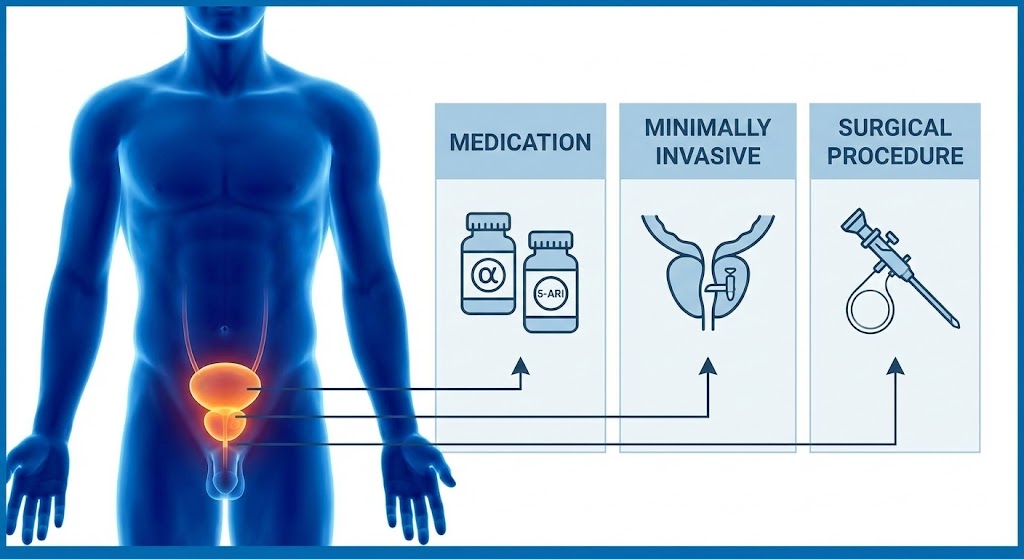
Treatment for BPH is not a linear path but a spectrum, chosen based on prostate size, symptom severity, your overall health, and personal preferences.
(Imagine a simple flowchart graphic here)
Mild Symptoms → Watchful Waiting & Lifestyle
Moderate-Severe Symptoms → Medical Therapy (Medications)
Medications Ineffective/Undesired → Minimally Invasive Therapies (MIST)
Large Prostate/Severe Symptoms → Surgical Therapies
Part 1: First-Line Medical Therapy – Medications for BPH
When lifestyle changes aren’t enough, medications are often the first step. They don’t shrink the prostate but manage symptoms effectively for millions of men.
A. Alpha-Blockers (e.g., Tamsulosin/Flomax, Alfuzosin, Silodosin)
- How They Work: Relax the smooth muscle in the prostate and bladder neck, like loosening a tight knot on a hose, to improve urine flow quickly.
- Best For: Rapid relief of obstructive symptoms (weak stream, hesitancy). Effects are felt in days.
- Key Considerations: Can cause side effects like dizziness (low blood pressure), fatigue, and retrograde ejaculation (dry orgasm). Our deep dive on Alpha-Blockers vs. 5-ARIs: Side Effects & Efficacy covers this in detail.
B. 5-Alpha Reductase Inhibitors (5-ARIs) (e.g., Finasteride, Dutasteride/Avodart)
- How They Work: Block the hormone (DHT) that causes prostate growth, slowly shrinking the prostate gland over 6-12 months.
- Best For: Men with significantly enlarged prostates. Reduces long-term risk of acute urinary retention and need for surgery.
- Key Considerations: Requires long-term use. Side effects can include decreased libido and erectile dysfunction. Not for small prostates.
C. Combination Therapy & PDE5 Inhibitors
- Alpha-Blocker + 5-ARI: Used for men with large prostates and severe symptoms to get both quick and long-term benefits.
- Tadalafil (Cialis): Yes, this ED medication is also FDA-approved for BPH. It works by relaxing bladder and prostate muscle. Learn more in our article: Tadalafil (Cialis) for BPH: Does it Work?.
Part 2: Minimally Invasive Surgical Therapies (MIST)
When medications cause side effects or don’t work well enough, MIST procedures offer a middle ground with less risk and faster recovery than major surgery.
1. UroLift®
- The Concept: Tiny implants act as “tent poles” to permanently hold the enlarged prostate tissue out of the way, opening the urethra.
- Pros: Rapid recovery (days), preserves ejaculation, performed in-office under local anesthesia.
- Cons: May not be as durable for very large prostates. Read our full comparison: UroLift for BPH: Pros, Cons, and What to Expect.
2. Rezūm™ Water Vapor Therapy
- The Concept: Injects sterile water vapor into the prostate tissue. The thermal energy destroys excess cells, which are then naturally reabsorbed by the body over 3-6 months, shrinking the prostate.
- Pros: Effective for a range of prostate sizes, preserves sexual function, minimally invasive.
- Cons: Symptoms may take weeks/months to fully improve as the body absorbs tissue. Explore the details: Rezūm Therapy: Procedure & Patient Reviews.
3. Other MIST Options
- Prostatic Artery Embolization (PAE): An interventional radiologist blocks blood flow to the prostate, causing it to shrink. Less common, evolving technique.
- TUMT/TUNA: Older microwave/radiofrequency therapies, largely supplanted by newer options.
Part 3: Surgical Treatment Options
For severe symptoms, very large prostates, or when complications (bladder stones, recurrent infections) arise, surgery is the gold standard for providing the most significant and durable improvement.
1. Transurethral Resection of the Prostate (TURP)
- The “Gold Standard”: A surgical scope removes blocking prostate tissue piece by piece. It’s the benchmark against which all other procedures are compared.
- Pros: Highly effective, long-lasting results, treats a wide range of sizes.
- Cons: Requires hospitalization, carries risks of bleeding, infection, and retrograde ejaculation is very common. Recovery takes weeks. See how it stacks up: TURP vs. Laser Surgery (GreenLight): Which is Right?.
2. Laser Surgeries (GreenLight PVP, HoLEP)
- The Concept: Uses laser energy to vaporize (GreenLight) or enucleate (HoLEP) prostate tissue with high precision.
- Pros: Reduced bleeding risk vs. TURP, often shorter hospital stay. HoLEP is especially effective for very large prostates.
- Cons: Requires specialized surgeon expertise. Potential for similar side effects as TURP.
What is recovery really like? Get an unfiltered look in our unique piece: BPH Surgery Recovery: One Man’s Diary (With Photos).
Part 4: Special Considerations & Supportive Care
Watchful Waiting: A Valid Strategy
For men with mild, non-bothersome symptoms, active monitoring is a legitimate option. It involves regular check-ups without immediate intervention. Learn the criteria in our guide: The Watchful Waiting Approach for Mild BPH.
Managing Complications: Catheter Care
Sometimes, temporary catheterization is needed before or after a procedure. Being informed reduces anxiety. Our guide covers BPH Catheterization: Types, Care, and Prevention.
The Risks of Doing Nothing
Understanding the potential consequences of untreated, severe BPH—like acute urinary retention, bladder damage, or kidney issues—is crucial for informed decision-making. We detail this in Long-Term Outlook for Untreated BPH.
Part 5: Your Action Plan – Articles in This Treatment Silo
| Article | Focus | Key Takeaway |
|---|---|---|
| #11: UroLift Guide | Minimally invasive implant procedure | Excellent option for preserving sexual function with quick recovery. |
| #12: Surgery Recovery Diary | Real patient experience post-TURP | An honest, visual account of the recovery journey week-by-week. |
| #13: TURP vs. GreenLight | Comparing laser and traditional surgery | A detailed breakdown of efficacy, side effects, and best use cases. |
| #14: BPH Medication Guide | Alpha-blockers vs. 5-ARI drugs | Understand how they work, their side effects, and which might suit you. |
| #15: Rezūm Therapy Guide | Water vapor treatment | How this tissue-destroying procedure works and its unique timeline. |
| #16: Watchful Waiting | Monitoring mild BPH | When it’s appropriate and how to monitor symptoms proactively. |
| #17: BPH Catheter Care | Managing temporary catheters | Practical tips for hygiene, comfort, and infection prevention at home. |
| #18: Tadalafil for BPH | Using Cialis for urinary symptoms | How an ED drug helps BPH and who it’s best for. |
| #19: Urologist Appointment Prep | Getting the most from your visit | 10 essential questions to ask to drive your treatment plan. |
| #20: Untreated BPH Risks | Consequences of severe, ignored BPH | Why managing significant symptoms is crucial for long-term health. |
Conclusion: Partnering for the Best Decision
Choosing a BPH treatment is a collaborative decision between you and your urologist. There is no single “best” option—only the best option for you, based on your anatomy, symptoms, lifestyle, and goals.
Your Next Steps:
- Get Informed: Use the articles above to research options that sound relevant.
- Quantify Your Symptoms: Complete a symptom score (IPSS) to bring to your appointment.
- Prepare to Engage: Use our list of 10 Key Questions for Your Urologist to ensure no question goes unanswered.
- Weigh Priorities: What matters most? Preserving ejaculation? Avoiding medication side effects? A one-time fix? Knowing this guides the conversation.
Effective treatment can restore your comfort, sleep, and quality of life. This hub is your roadmap to getting there.
Navigate Our Complete BPH Hub:
- Silo 1: BPH Symptoms & Daily Management: Understand and track your condition.
- Silo 2: Medical & Surgical Treatments (You are here)
- Silo 3: Natural Remedies & Lifestyle: Support your prostate health holistically.
- Main Hub: The Complete Guide to BPH & Prostate Health: Return to the central overview.
FAQs
1. What is the most effective treatment for BPH?
The “most effective” treatment depends on your specific situation. For large prostates causing severe obstruction, surgery like TURP or HoLEP offers the most significant and durable improvement. For moderate symptoms, medications or minimally invasive procedures (MIST) like UroLift can be highly effective with fewer side effects. “Effective” balances symptom relief with risk tolerance.
2. Do BPH medications like Flomax shrink the prostate?
No. Alpha-blockers (e.g., Flomax) work by relaxing muscles, not shrinking tissue. 5-ARI medications (e.g., Finasteride, Avodart) do actually shrink the prostate over 6-12 months by blocking the growth-stimulating hormone DHT.
3. What is the least invasive surgery for BPH?
Minimally Invasive Surgical Therapies (MIST), such as the UroLift procedure, are considered the least invasive. They are often performed in a doctor’s office under local anesthesia, have recovery times measured in days, and typically preserve sexual function. Rezūm water vapor therapy is another minimally invasive option.
4. How long does it take to recover from TURP surgery?
Initial hospital recovery is 1-3 days. Most men can return to desk work within 1-2 weeks. However, full recovery—where all bleeding stops, urination normalizes, and you can resume strenuous activity and heavy lifting—typically takes 4 to 6 weeks. See a real-life timeline in our BPH Surgery Recovery Diary.
5. Can BPH treatment cause erectile dysfunction (ED)?
Some treatments can affect erectile function. 5-ARI medications list ED and decreased libido as potential side effects. Surgical options like TURP carry a risk of ED (though lower with modern techniques). Importantly, MIST procedures like UroLift and Rezūm are specifically designed to preserve erectile function.
6. What happens if I just live with BPH and don’t treat it?
For mild symptoms, “watchful waiting” is safe. However, if symptoms are moderate to severe and left untreated, you risk progressive worsening, including acute urinary retention (a painful inability to urinate), bladder stones, recurrent UTIs, and, in rare cases, kidney damage. Learn more in our guide to Untreated BPH Risks.
7. Is retrograde ejaculation permanent after BPH surgery?
With surgeries that remove or reshape the bladder neck (like TURP and laser enucleation), retrograde ejaculation (where semen goes backward into the bladder) is very common and is usually permanent. This is a key trade-off for the significant symptom relief. Procedures like UroLift are specifically designed to avoid this side effect.
8. Will I need a catheter after my BPH procedure?
It’s very common. Most surgical procedures (TURP, laser) require a temporary Foley catheter for 1-3 days to allow healing and drainage. Some MIST procedures may also use one for a shorter period (24 hours). Our Catheter Care Guide helps you prepare.
9. Can I stop taking BPH medications after a procedure?
A primary goal of surgical and many MIST procedures is to reduce or eliminate the need for daily BPH medications. Success is often measured by whether you can stop taking drugs like Flomax. This is a key question to discuss with your surgeon before any procedure.
10. How do I choose between UroLift, Rezūm, and TURP?
This is the core decision for many. Key factors: Prostate size (UroLift best for small/medium), desire to preserve ejaculation (UroLift/Rezūm), severity of symptoms (TURP best for most severe), and recovery time (UroLift fastest). Our detailed comparisons in articles #11 and #13 will help you weigh these options.
Related Articles
- BPH Symptoms & Daily Management Hub: Not sure about your symptom severity? Start here with tracking and non-medical strategies.
- Natural Remedies & Lifestyle for Prostate Health: Explore how diet, exercise, and supplements can support your treatment plan.
- BPH Self-Assessment Quiz & Symptom Tracker: Quantify your symptoms to bring hard data to your urologist appointment.
- Chronic Prostatitis vs. BPH: Ensure your urinary symptoms are correctly diagnosed before pursuing BPH-specific treatments.
Your Journey to Better Prostate Health Starts Here
This article is just one part of our complete, 30+ article resource on BPH and prostate health.
From first symptoms to treatment recovery, natural remedies to surgical deep dives—we’ve covered it all in one place.
🗺️ Explore The Complete BPH & Prostate Health HubInside: Symptom Trackers | Treatment Comparisons | Recovery Diaries | Diet Plans | FAQs | and much more.

Medically Reviewed for Accuracy
This content has been reviewed for accuracy and clarity by The Health Knowledge Base Medical Review Team, using current research and evidence-based health guidance.
Our review process helps ensure that information related to health, wellness, nutrition, lifestyle strategies, and natural support topics reflects current scientific understanding and responsible editorial standards.
Written by The Health Knowledge Base Editorial Team
Our editorial team consists of health researchers, wellness writers, and content specialists focused on creating clear, practical, and research-informed health content.
We publish educational articles designed to help readers better understand health topics, explore natural wellness strategies, and make more informed lifestyle decisions with confidence.
Affiliate Transparency, Medical Disclaimer & Safety Notice
At The Health Knowledge Base, we take pride in being a trusted resource and affiliate partner with select, high-quality companies. We choose these partnerships carefully because we genuinely believe their products, services, and educational resources align with the values and mission of our website.
When you purchase through certain links on this site, we may receive a small commission or compensation. This helps support our research, content creation, and ongoing work at no additional cost to you. Your price remains exactly the same.
Medical Disclaimer
The information provided by The Health Knowledge Base is for general informational and educational purposes only and is not a substitute for professional medical advice, diagnosis, or treatment.
Always seek the advice of your physician, doctor, or another qualified healthcare provider with any questions you may have regarding a medical condition, symptoms, treatment options, diet changes, exercise programs, or supplements.
Never disregard professional medical advice or delay in seeking it because of something you have read on this website.
Critical Safety Notice
Before making any changes to your diet, starting a new fitness or wellness routine, or taking any supplements mentioned on this site, you should consult with your doctor, physician, or another qualified healthcare professional. Reliance on any information provided by The Health Knowledge Base is solely at your own risk.
View our Affiliate Disclosure → | View our Medical Disclaimer →