






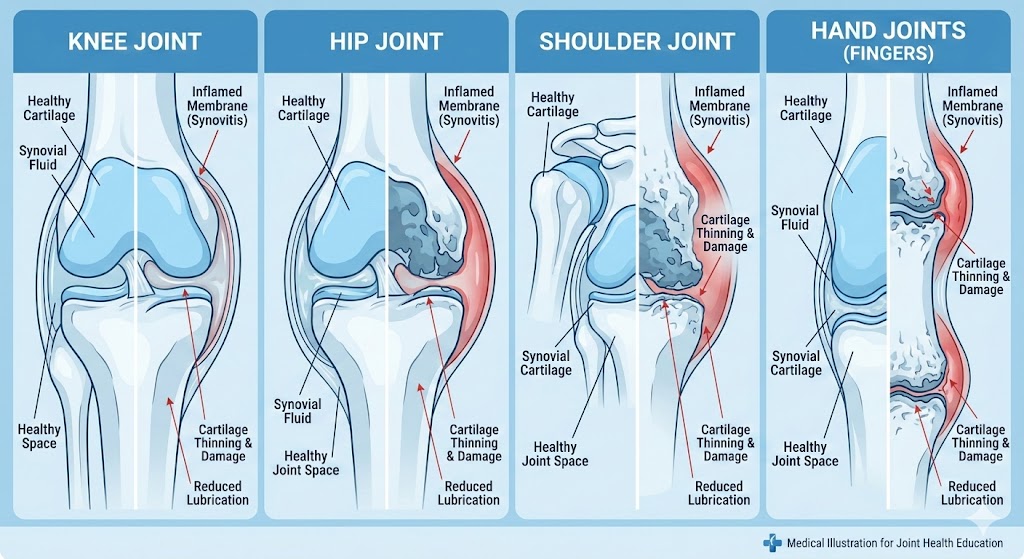
Joint pain affects millions of people worldwide—limiting movement, disrupting sleep, and gradually reducing quality of life. Whether it shows up as knee stiffness, hip discomfort, shoulder restriction, or swollen fingers, joint pain is rarely random.
It is often the result of deeper structural and biological changes, including:
- Chronic inflammation
- Cartilage wear and thinning
- Reduced synovial fluid (joint lubrication)
- Age-related tissue breakdown
- Repetitive stress or excess joint load
This Joint Pain Health Hub was created to help you understand why joint pain develops—and what you can do to support your joints naturally, safely, and long-term.
🔍 What Causes Joint Pain?
Joint pain can develop gradually or appear suddenly, depending on the underlying mechanism. The most common contributors include:
- Osteoarthritis and cartilage degeneration
- Inflammatory signaling (cytokines, prostaglandins)
- Loss of joint lubrication
- Muscle imbalance or joint instability
- Age-related collagen decline
- Weight-related joint overload
Understanding the root cause of your joint discomfort is essential—because different causes require different solutions.
🦵 Types of Joint Pain Covered in This Hub
Use the sections below to explore joint pain by location, mechanism, or support strategy.
🦵 Knee Joint Pain
The knees absorb more force than almost any other joint. Over time, this can lead to pain during walking, stairs, or standing.
👉 Explore:
- Causes of knee pain and swelling
- Cartilage wear and osteoarthritis
- Exercises to avoid with knee pain
- Natural joint support strategies
🔗 Visit the Knee Pain Silo
🦶 Hip Joint Pain
Hip pain often affects mobility, sleep, and posture. It may originate from cartilage loss, inflammation, or muscle tightness surrounding the joint.
👉 Explore:
- Hip arthritis and stiffness
- Groin and side-hip pain
- Night-time hip discomfort
- Mobility and joint support options
🔗 Visit the Hip Pain Silo
💪 Shoulder Joint Pain
Shoulder joints rely heavily on stability and range of motion. Inflammation or tissue damage can quickly restrict daily movement.
👉 Explore:
- Frozen shoulder
- Rotator cuff inflammation
- Pain when lifting the arm
- Sleep-related shoulder pain
🔗 Visit the Shoulder Pain Silo
✋ Hand, Wrist & Finger Joint Pain
Small joints are especially vulnerable to inflammation and degenerative changes, often presenting as morning stiffness or reduced grip strength.
👉 Explore:
- Finger and hand arthritis
- Swollen or stiff joints
- Loss of dexterity and grip
- Nutritional joint support
🔗 Visit the Hand & Finger Pain Silo
🔥 Joint Inflammation & Chronic Pain Signals
Inflammation is one of the most overlooked drivers of ongoing joint pain. When inflammatory signals remain active, joint tissues struggle to heal.
👉 Explore:
- Why joint inflammation becomes chronic
- Diet and inflammatory load
- Natural anti-inflammatory compounds
- Why pain relievers fail long-term
🔗 Visit the Joint Inflammation Silo
🧬 Cartilage, Lubrication & Joint Degeneration
Healthy joints depend on cartilage cushioning and synovial fluid lubrication. When these systems decline, friction and pain increase.
👉 Explore:
- Cartilage breakdown causes
- Can cartilage regenerate?
- Collagen, hyaluronic acid & joint support
- Long-term joint cushioning strategies
🔗 Visit the Cartilage Health Silo
💊 Joint Supplements & Natural Support
Not all joint supplements are created equal. Some target inflammation, others focus on cartilage integrity or lubrication.
👉 Explore:
- What joint supplements actually do
- Key ingredients for joint comfort
- What to avoid in joint formulas
- Safety and dosage considerations
🧠 Joint Pain by Age & Lifestyle
Joint pain often worsens with age—but lifestyle factors play a major role.
👉 Explore:
- Joint pain after 40
- Morning stiffness causes
- Weather-related joint pain
- Weight and joint stress
🔗 Explore Lifestyle & Age Factors
❓ FAQs (Frequently Asked Questions)
1. What is the most common cause of joint pain?
The most frequent cause is osteoarthritis (OA), a degenerative condition where the protective cartilage on the ends of the bones wears down over time.
2. Can joint pain be caused by inflammation alone?
Yes. While structural damage is common, systemic inflammation (as seen in rheumatoid arthritis or dietary-induced inflammation) can cause significant pain even before major cartilage loss occurs.
3. Does cartilage wear always lead to arthritis?
“Arthritis” is a broad term for joint inflammation or damage. Cartilage wear is a primary component of osteoarthritis; while the wear itself is a process, the resulting pain and stiffness are what characterize the clinical condition of arthritis.
4. Why is joint pain worse in the morning?
During sleep, joint lubrication (synovial fluid) can thicken and inflammatory byproducts can accumulate in the joint space. Movement helps “thaw” the joint by circulating fluid and increasing blood flow.
5. Can supplements really support joint health?
Specific ingredients like glucosamine, chondroitin, turmeric, and hyaluronic acid have been shown to help manage inflammation and support the biological building blocks of joint tissue, though results vary by individual.
6. Which joints are most affected by aging?
Weight-bearing joints—specifically the knees, hips, and lower spine—along with the frequently used joints of the fingers and hands, are most susceptible to age-related wear.
7. How does weight affect joint pain?
Excess weight increases the mechanical “load” on joints (especially knees and hips). Additionally, fat tissue produces pro-inflammatory chemicals that can chemically degrade joint tissues.
8. Are NSAIDs safe for long-term joint pain?
Non-steroidal anti-inflammatory drugs (NSAIDs) are effective for short-term relief but carry risks for long-term use, including potential gastrointestinal issues, kidney stress, and cardiovascular concerns.
9. Can joint lubrication be restored naturally?
While you cannot “refill” a joint like a reservoir, staying hydrated, maintaining movement to stimulate synovial fluid production, and consuming healthy fats and hyaluronic acid can support better joint viscosity.
10. When should joint pain be medically evaluated?
You should seek medical advice if pain is accompanied by swelling, redness, heat, a fever, or if the pain significantly limits your ability to perform basic daily activities.
Explore Joint Pain by Location & Root Cause
Joint pain is not one-size-fits-all. Whether your discomfort affects your knees, hips, shoulders, or hands, understanding the specific joint involved is the first step toward targeted relief and long-term support.
- Knee Joint Pain – Cartilage wear, swelling, osteoarthritis, and mobility concerns
- Hip Joint Pain – Stiffness, night discomfort, and range-of-motion issues
- Shoulder Joint Pain – Inflammation, rotator cuff problems, and restricted movement
- Hand & Finger Joint Pain – Arthritis, stiffness, and grip strength loss
- Joint Inflammation – The hidden driver of swelling and chronic pain
- Cartilage Breakdown – Why cushioning fails and friction increases over time
Start with the area or mechanism that best matches your symptoms and build a smarter, more personalized joint support plan.