





Why Posture Matters More Than People Think
Posture is often dismissed as an aesthetic issue—something that affects appearance more than health. In reality, posture is a mechanical signal that determines how spinal discs are loaded, hydrated, and stressed throughout the day.
Over time, repeated poor posture does not usually cause sudden injury—but it can accelerate disc degeneration, increase inflammation, and lower the spine’s tolerance to normal movement. Understanding how posture damages discs helps explain why pain often develops slowly and why imaging findings don’t always match symptoms.
Structural Overview: Spine and Disc Pain: Structural Causes & Natural Support
What “Posture Damage” Really Means
Posture damage does not mean a single bad position causes immediate harm. Instead, it refers to:
- Repeated loading in suboptimal positions.
- Prolonged static postures (staying in one spot too long).
- Reduced movement variability.
Over time, these factors change how discs adapt to stress.
How Posture Affects Spinal Discs
Spinal discs respond to how force is applied, not just how much force exists.
- Good Posture: Distributes load evenly, allows fluid exchange, and reduces focal stress.
- Poor Posture: Concentrates pressure in specific disc regions, limits disc rehydration, and increases mechanical strain.
These effects accumulate gradually, affecting the long-term integrity of the spinal structures.
Common Postural Patterns That Stress Discs
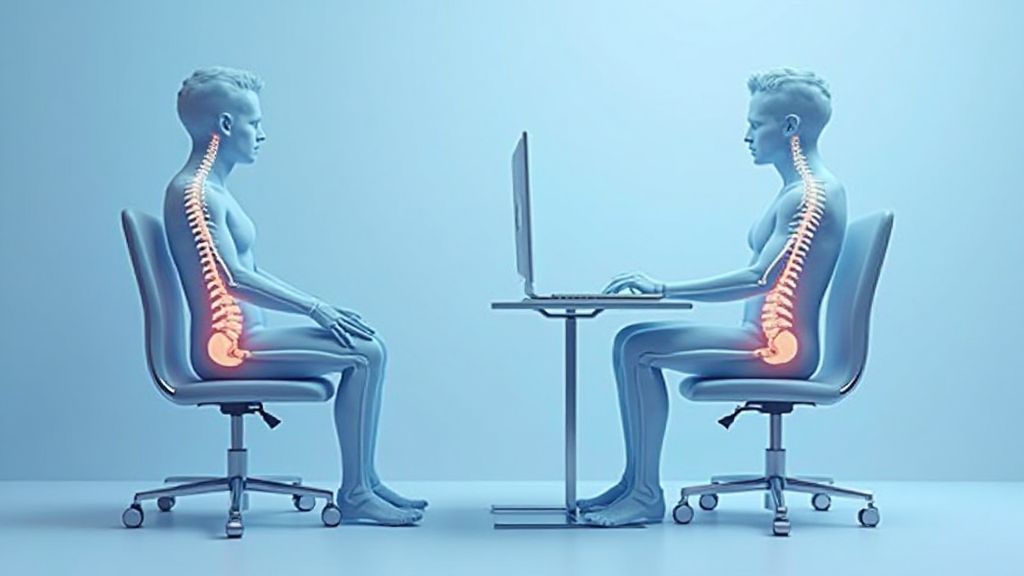
Prolonged Sitting With Flexed Spine
This posture increases internal disc pressure, pushes disc material posteriorly (toward the nerves), and limits nutrient diffusion. Over time, it lowers disc load tolerance.
Related Reading: Sitting All Day and Lower Back Pain: Why It Happens
Forward Head and Rounded Upper Back
Although often associated with neck pain, this posture alters spinal alignment and changes load distribution along the entire spine, increasing compensatory stress in the lumbar region.
Static Standing Postures
Standing without movement—especially with an anterior pelvic tilt or locked knees—can increase lumbar compression and fatigue stabilizing muscles.
Why Posture Accelerates Disc Degeneration
Disc degeneration is influenced by age, genetics, load exposure, and inflammation. Posture does not cause degeneration by itself, but it can accelerate degenerative changes by increasing uneven stress over time.
For Clarity: Degenerative Disc Disease Explained
Posture, Inflammation, and Pain Sensitivity
Poor posture can increase mechanical irritation and trigger low-grade inflammation, which sensitizes nearby nerves. This explains why pain can worsen even when structural changes appear mild on an X-ray or MRI.
Related Context: Inflammation vs. Injury: Understanding the Difference
Why Posture-Related Pain Fluctuates
Posture-driven disc pain often improves with movement and worsens with prolonged positions. You may feel stiff after rest. These fluctuations reflect load intolerance, not necessarily worsening damage.
Disc Recovery Behavior: Why Spinal Discs Heal Slowly
Can Improving Posture Reverse Disc Degeneration?
No. Posture correction does not restore lost disc height or regenerate discs. However, it can:
- Reduce ongoing mechanical stress.
- Improve symptom control.
- Increase disc load tolerance.
Related Reading: Can Spinal Discs Regenerate Naturally?
Why “Perfect Posture” Is the Wrong Goal
Chasing “perfect” posture often backfires by creating muscle tension. Better goals include:
- Frequent position changes (The best posture is your next posture).
- Reduced static loading.
- Comfortable, adaptable alignment.
Movement variability protects discs more than rigid posture.
Supporting Disc Health Beyond Posture
Disc health also depends on hydration, movement patterns, inflammation control, and nervous system regulation.
Broader Approach: Back Pain Supplements: Evidence-Based Support Options
When to Seek Medical Evaluation
Seek medical care if posture-related pain includes:
- Progressive neurological symptoms.
- Worsening weakness or numbness.
- Loss of bowel or bladder control.
FAQs
- Can poor posture cause disc degeneration?
It can accelerate stress but is not the sole cause. - Does fixing posture reverse disc damage?
No, but it may reduce symptoms. - Is sitting worse than standing?
Prolonged static positions are the main issue, regardless of whether you are sitting or standing. - Why does posture-related pain fluctuate?
Because load tolerance changes throughout the day based on activity and inflammation. - Is slouching always bad?
Not if it’s brief—static, long-term slouching is the problem. - Does posture affect nerve pain?
Yes, it can increase mechanical irritation on sensitized nerves. - Can posture changes help chronic pain?
Often, yes, especially when combined with movement and lifestyle changes. - Is perfect posture necessary?
No—movement variability and position changes matter more. - Does posture show on imaging?
No, functional stress and load intolerance are not visible on standard scans. - When should I see a doctor?
If you experience worsening neurological symptoms or a loss of function.
Protect Your Discs Through Smarter Movement
Disc health improves with balanced loading, movement variability, and reduced inflammation—not rigid posture rules.