





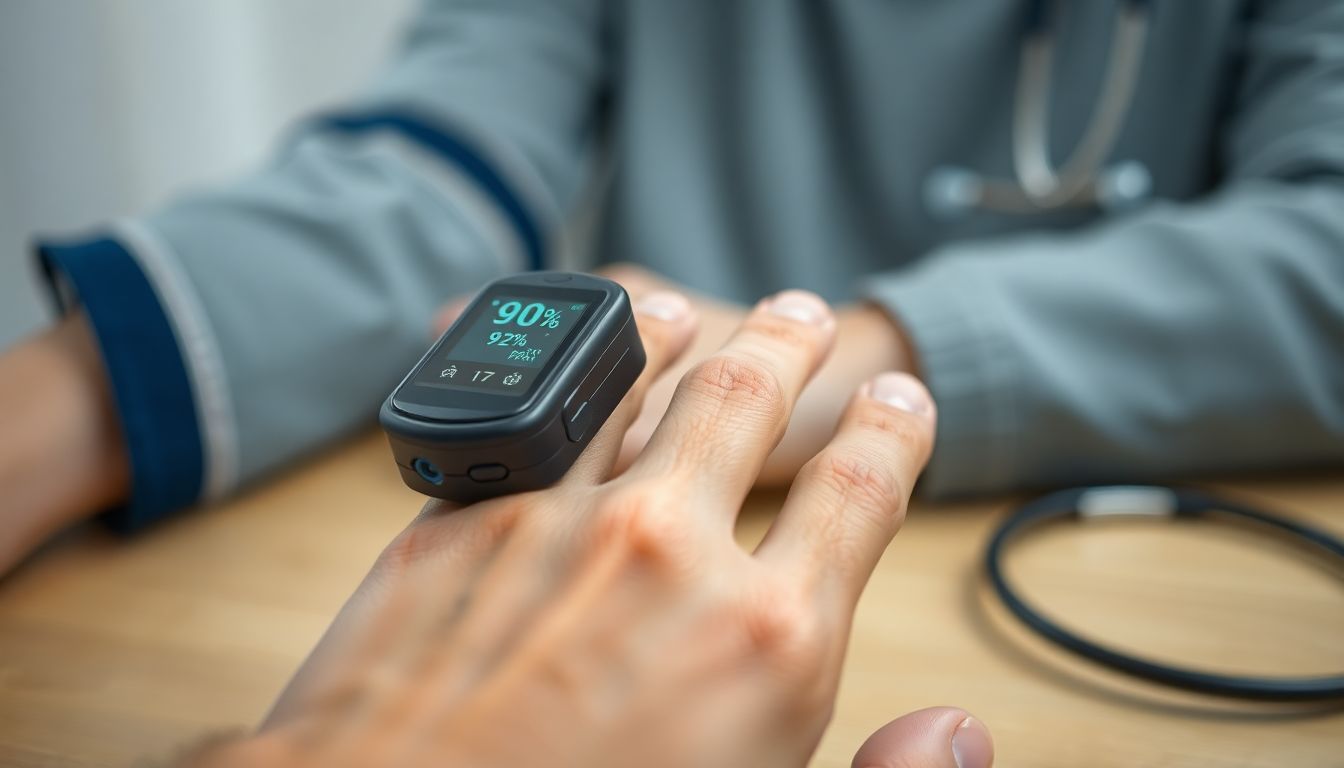
That little clip-on device has become a household staple. You slip it on your finger, wait a few seconds, and two numbers appear: one for your blood oxygen and one for your pulse. You know that 98% is “good” and a low number is “bad,” but what does it all really mean?
A pulse oximeter is a powerful tool, but without context, its numbers can be a source of confusion or unnecessary anxiety.
This guide goes beyond the basics to give you a deep, practical understanding of your pulse oximetry readings. You’ll learn how to interpret the trends, understand the limitations, and use this data as part of a comprehensive strategy for better breathing, like the one outlined in our Ultimate Guide to Clearing Mucus & Restoring Lung Health Naturally.
A 30-Second Science Lesson: What is SpO2?
SpO2 (Peripheral Oxygen Saturation) is the percentage of your red blood cells that are carrying oxygen.
Think of your red blood cells as a fleet of delivery trucks. SpO2 tells you what percentage of those trucks are currently full of oxygen and making deliveries to the tissues in your body.
- Hemoglobin = The delivery truck
- Oxygen = The cargo
- SpO2 of 98% = 98% of your delivery trucks are full of cargo.
The SpO2 Chart: What Your Number Really Means
While the classic “95-100% is normal” rule is a good starting point, the context of your health is everything.
| SpO2 Reading | What It Typically Means | Action to Take |
|---|---|---|
| 95% – 100% | Normal Range. Your lungs are efficiently oxygenating your blood. | Continue your normal activities and monitoring. |
| 92% – 94% | Borderline / Concerning. This is a sign to pay close attention, especially if this is a drop from your normal baseline. | Rest and re-check. If it persists or you feel short of breath, call your doctor. This is a common threshold discussed in at-home lung monitoring plans. |
| 88% – 91% | Clinically Low. This indicates hypoxemia (low blood oxygen). For many with chronic lung disease, this is the target for supplemental oxygen therapy. | Contact your doctor. If you are on oxygen, ensure you are using it. |
| Below 88% | Medical Alert. This is a dangerously low level of oxygen that requires immediate attention. | Seek emergency medical care. |
Crucial Note: Some people with chronic lung conditions like severe COPD may have a consistently lower “normal” baseline (e.g., 90-92%). The most important thing is to know your baseline and watch for significant changes.
Beyond the Percentage: The Power of Trends & Context
A single reading is a snapshot; a trend is the movie. Don’t panic over one low reading. Instead, ask these questions:
- Is this a trend? Are your numbers gradually dropping over days?
- What was I doing? Did it drop during or right after activity? Tracking this can help you pace yourself, a key part of managing conditions like COPD.
- How do I feel? Your symptoms are as important as the number. A reading of 94% with severe shortness of breath is more concerning than a reading of 94% while feeling fine.
The Second Number: What Your Pulse Rate is Telling You
Your pulse rate (heart rate) is the other half of the story. Your heart and lungs are a team.
- Normal Resting Heart Rate: Typically 60-100 beats per minute (BPM).
- High Heart Rate (Tachycardia): When your oxygen levels drop, your heart may beat faster to try to deliver what little oxygen is available more quickly around the body. A rising heart rate can sometimes be an earlier sign of respiratory distress than a falling SpO2.
- Low Heart Rate (Bradycardia): While often a sign of good fitness, a very low heart rate with low SpO2 can be a sign of a serious problem.
Watch the Partnership: A falling SpO2 coupled with a rising heart rate is a significant red flag that your body is under stress.
5 Reasons Your Pulse Ox Reading Might Be Wrong
Pulse oximeters are useful, but they have limitations. Before you panic over a low number, check these common pitfalls:
- Poor Circulation or Cold Hands: Your fingers need good blood flow for an accurate reading. If your hands are cold, warm them up and try again.
- Nail Polish or Artificial Nails: Dark polish, especially black or blue, can block the light sensor and give falsely low readings.
- Movement: Shaking or shivering can interfere with the sensor. Sit still, rest your hand on a table, and breathe normally.
- Skin Pigmentation: Studies have shown that pulse oximeters can sometimes overestimate oxygen levels in people with darker skin tones, especially in low-oxygen situations. Be aware of this limitation and pay extra attention to your symptoms.
- A Weak Device: Cheap, unapproved devices may not be accurate. Look for devices that are “FDA-cleared” or “FDA-listed” for medical use.
How to Get the Most Accurate Reading Every Time
- Sit Still: Rest for at least 5 minutes before taking a reading.
- Warm Your Hands: Rub them together if they’re cold.
- Position Correctly: Place the oximeter on a middle or index finger. Your hand should be at heart level or lower.
- Wait for Stability: Wait until the numbers stop fluctuating for a consistent reading (usually 10-30 seconds).
- Take Multiple Readings: Check the reading on a couple of different fingers to ensure consistency.
When to Call Your Doctor: The Red Flags
Use your pulse ox as a guide, not a replacement for medical judgment. Contact your doctor if you notice:
- Your SpO2 is consistently at or below 92% at rest.
- Your SpO2 drops significantly (by 4-5 points or more) with mild activity, like walking around your home.
- You need to increase your supplemental oxygen flow rate to maintain your target SpO2.
- You have a low SpO2 reading and symptoms like increased shortness of breath, chest pain, or confusion.
Conclusion: From Data to Empowerment
Your pulse oximeter is a window into the intimate partnership between your heart and lungs. By looking beyond the basic numbers—by understanding trends, context, and potential pitfalls—you transform it from a simple gadget into a powerful tool for self-awareness.
This knowledge allows you to have informed conversations with your doctor and take a proactive role in your health, a core principle of the comprehensive lung health strategies we champion. Breathe easy, knowing you’re now equipped to understand what your body is telling you.
FAQs
1. What is a normal SpO2 level for a person with COPD?
For most healthy individuals, normal is 95% or higher. However, for many with COPD, a “normal” baseline might be lower, often between 88% and 92%. The key is to know your personal baseline when you are stable. Doctors often prescribe supplemental oxygen if your SpO2 is 88% or below.
2. Why does my oxygen level drop when I walk?
This is called exertional desaturation. When you exercise, your muscles need more oxygen. If your lungs can’t keep up with the increased demand (due to obstructed or damaged airways), your SpO2 will drop. This is a common sign in COPD and other lung diseases and is a key metric to track as part of your at-home lung monitoring.
3. Can a pulse oximeter detect a silent asthma attack?
It can be an indicator, but not always. In a severe asthma attack (status asthmaticus), SpO2 will eventually drop. However, in the early stages, you may feel extremely short of breath while your SpO2 is still in the 90s because the main problem is moving air out, not getting oxygen in. Always treat asthma based on symptoms and peak flow, not just SpO2.
4. What is the difference between a pulse ox and a spirometer?
A pulse oximeter measures how well your lungs are oxygenating your blood (SpO2). A spirometer (like the ones we discuss in how to read spirometry results) measures how much air your lungs can hold and how fast you can move it (lung function). They measure two different, but related, things.
5. How accurate are smartphone pulse oximeter apps?
They are generally not reliable for medical use. These apps use the phone’s camera and flash, which is not the same as the calibrated, dual-wavelength light sensors in a medical-grade device. For accurate readings, always use a dedicated finger pulse oximeter.
6. Why is my heart rate high on the pulse oximeter?
A high heart rate can be due to many factors, including low oxygen levels, pain, anxiety, dehydration, fever, or simply recent physical activity. If your resting heart rate is consistently high (over 100 BPM) and you are unsure why, it’s a good idea to discuss it with your doctor.
7. What does a “poor signal” reading mean?
This means the device is not getting a clear reading from your finger. This is usually due to cold hands, poor circulation, or movement. Warm your hands, sit still, and try a different finger. If it persists, the device’s batteries may be low.
8. Can anxiety cause low SpO2 readings?
Typically, no. Anxiety can cause you to feel short of breath (a phenomenon explored in breathing through anxiety), but it does not usually cause a genuine drop in blood oxygen saturation. However, hyperventilating from anxiety can sometimes cause a slight, temporary increase in SpO2.
9. What is a normal SpO2 level during sleep?
It’s normal for SpO2 to dip slightly during sleep, but it should generally stay above 90%. Consistent drops below 88-90% during sleep can be a sign of sleep apnea, a condition where breathing repeatedly stops and starts, and should be evaluated by a doctor.
10. When should I go to the ER for low oxygen?
You should seek immediate emergency care if your SpO2 is 88% or below and does not quickly improve with rest or your prescribed oxygen, especially if this is accompanied by severe shortness of breath, chest pain, confusion, or a bluish color in your lips or face.
Still Have Questions? We Have Answers.
Lung health is complex. If you’re wondering “What about…?” or “What’s next for me?”, you’re not alone. Our Resource Hub is built to be your **first stop for trustworthy, in-depth answers** on every aspect of respiratory wellness.
- Condition-Specific Guides (COPD, Asthma, Post-COVID)
- Step-by-Step Detox & Recovery Plans
- Science-Backed Natural & Conventional Strategies