






Not all testosterone booster ingredients are created equal.
Some have strong scientific support, while others rely on early research or traditional use. Understanding the difference between these ingredients is essential if you want to make informed decisions about supplements.
In this guide, we break down the most common testosterone-boosting ingredients and rank them based on their level of scientific evidence.
Why Ingredient Quality Matters
Many testosterone supplements combine multiple ingredients, but the effectiveness of a product depends on:
- ingredient quality
- clinical dosage
- scientific evidence
- how ingredients interact
Before choosing a supplement, it’s important to understand how testosterone boosters actually work: Testosterone Boosters Explained: What They Are (and What They’re Not)
Evidence Tiers Explained
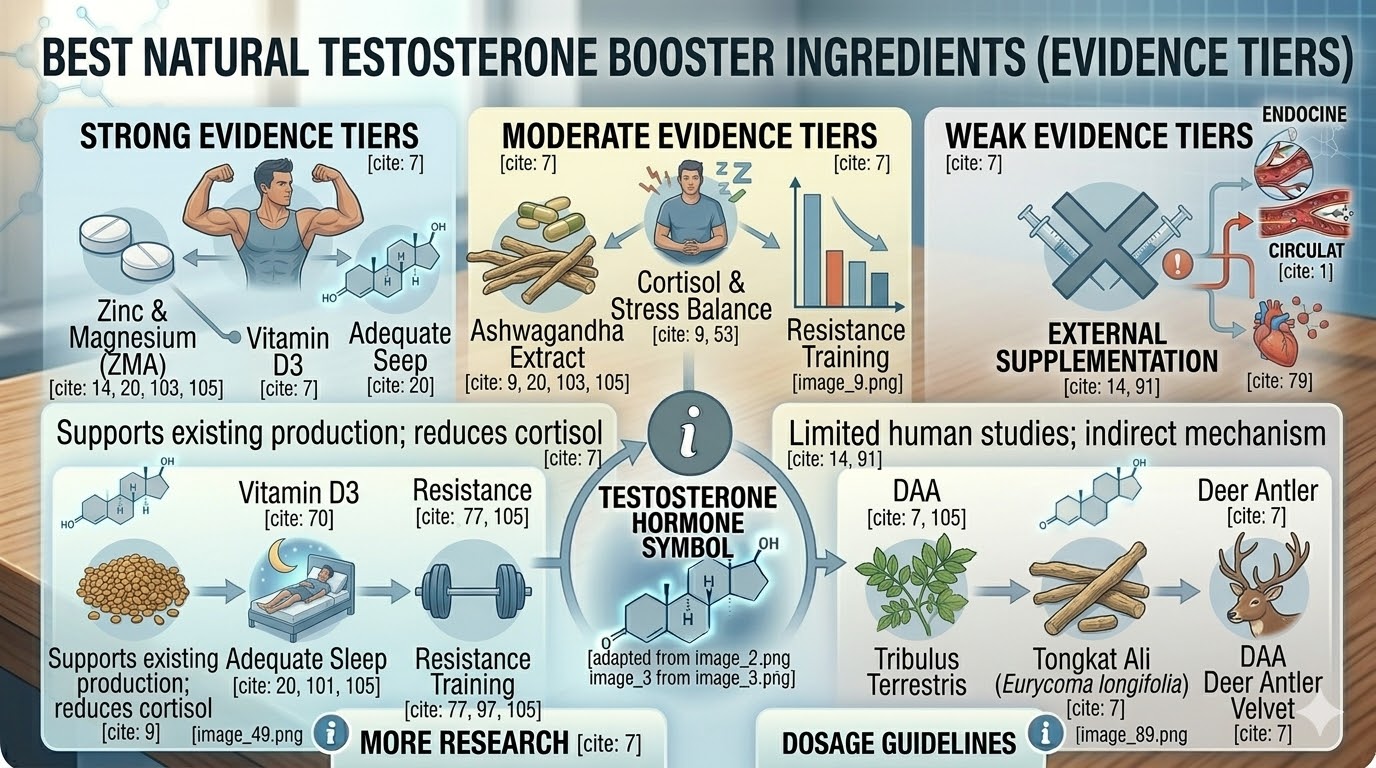
To simplify the science, we categorize ingredients into three tiers:
Tier 1 — Strong Evidence
Supported by multiple human studies
Tier 2 — Moderate Evidence
Some human data or strong indirect evidence
Tier 3 — Limited Evidence
Early research, animal studies, or traditional use
Tier 1 — Strong Evidence Ingredients
These ingredients have the most reliable scientific support for supporting testosterone or hormone balance.
Zinc
Zinc plays a critical role in testosterone production.
Deficiency in zinc has been strongly linked to reduced testosterone levels.
Supplementation may help restore testosterone in individuals who are deficient.
Learn more: Zinc, Magnesium, and Vitamin D for Testosterone
Vitamin D
Vitamin D functions more like a hormone than a traditional vitamin.
Low vitamin D levels are associated with lower testosterone in many studies.
Restoring optimal levels may support hormone health.
Magnesium
Magnesium supports multiple biological processes, including muscle function and hormone regulation.
Some studies suggest magnesium may help increase free testosterone, particularly in active individuals.
Tier 2 — Moderate Evidence Ingredients
These ingredients show promising results but may not have as much consistent human research.
Ashwagandha
Ashwagandha is an adaptogenic herb that helps reduce stress and cortisol.
Lower cortisol levels may support testosterone production.
Some studies also show improvements in strength and recovery.
Explore more: Ashwagandha and Testosterone: Stress, Sleep, and Performance Support
Tongkat Ali
Tongkat Ali has been studied for its potential to support testosterone levels and reduce stress.
Some research suggests it may help improve mood, libido, and hormone balance.
Learn more: Tongkat Ali for Testosterone: Benefits, Dosage, and Safety
Fenugreek
Fenugreek is commonly used in testosterone supplements.
Some studies suggest it may support libido and free testosterone levels, though results are mixed.
See: Fenugreek for Testosterone and Libido: What Studies Suggest
Tier 3 — Limited or Emerging Evidence
These ingredients are often included in supplements but have less consistent research.
D-Aspartic Acid
D-aspartic acid has been studied for testosterone support, but results are inconsistent.
Some studies show short-term increases, while others show no significant effect.
Fadogia Agrestis
Fadogia has gained attention in recent years, but most evidence comes from animal studies.
Human safety data is limited.
Learn more: Fadogia Agrestis: What We Know (and Safety Concerns)
DHEA
DHEA is a hormone precursor that can convert into testosterone or estrogen.
Its effects vary depending on age and individual hormone status.
Explore further: DHEA for Men: When It’s Useful and When to Avoid It
DIM (Diindolylmethane)
DIM does not directly increase testosterone but may help regulate estrogen balance.
This may be relevant in specific hormonal situations.
See: DIM and Estrogen Balance in Men: When It Matters
The Role of Lifestyle (More Important Than Supplements)
Even the best ingredients cannot replace foundational habits.
Testosterone is strongly influenced by:
- sleep quality
- stress levels
- body composition
- training habits
For example: Sleep and Testosterone: How Deep Sleep Drives Hormone Production and Body Fat and Testosterone: Why Belly Fat Lowers T
How to Choose a Quality Testosterone Supplement
When evaluating supplements, consider:
- transparent ingredient labels
- clinically relevant dosages
- third-party testing
- realistic claims
Avoid products that promise extreme or rapid results.
Final Thoughts
The effectiveness of testosterone boosters depends largely on the ingredients they contain.
Some ingredients, such as zinc and vitamin D, have strong evidence — particularly when deficiencies are present.
Others may provide indirect support through stress reduction or recovery.
Understanding evidence tiers helps you separate science-backed ingredients from marketing hype, allowing you to make more informed decisions.
Frequently Asked Questions
What is the best natural testosterone booster ingredient?
Zinc, vitamin D, and magnesium have the strongest evidence, especially in individuals with deficiencies.
Do herbal supplements increase testosterone?
Some herbs may support hormone balance indirectly, but effects are usually modest.
Are testosterone booster ingredients safe?
Most are safe when used appropriately, but quality and dosage vary between products.
How long do these ingredients take to work?
Effects may take several weeks and depend on overall lifestyle and health status.
Should I take multiple ingredients together?
Some supplements combine ingredients, but effectiveness depends on proper dosing and formulation.
Can I get these nutrients from food instead of supplements?
Yes. Zinc, magnesium, and vitamin D can be obtained from whole foods, though supplementation may help correct deficiencies.
Do I need to cycle testosterone booster ingredients?
Most natural ingredients do not require cycling, but following product instructions is recommended.
Are testosterone boosters safe for younger men?
Younger men with healthy testosterone levels generally do not need supplements. Lifestyle habits should be the priority.
Can women take testosterone booster ingredients?
Some ingredients may be suitable for women, but hormonal effects differ. Consultation with a healthcare provider is advised.
Do these ingredients cause side effects?
Mild side effects such as digestive discomfort may occur in some individuals, depending on the ingredient and dosage.
Explore the Complete Testosterone Health Hub
Discover how lifestyle, nutrition, and science-backed supplements work together to support testosterone health and long-term performance.
Visit the Testosterone Health Hub →