






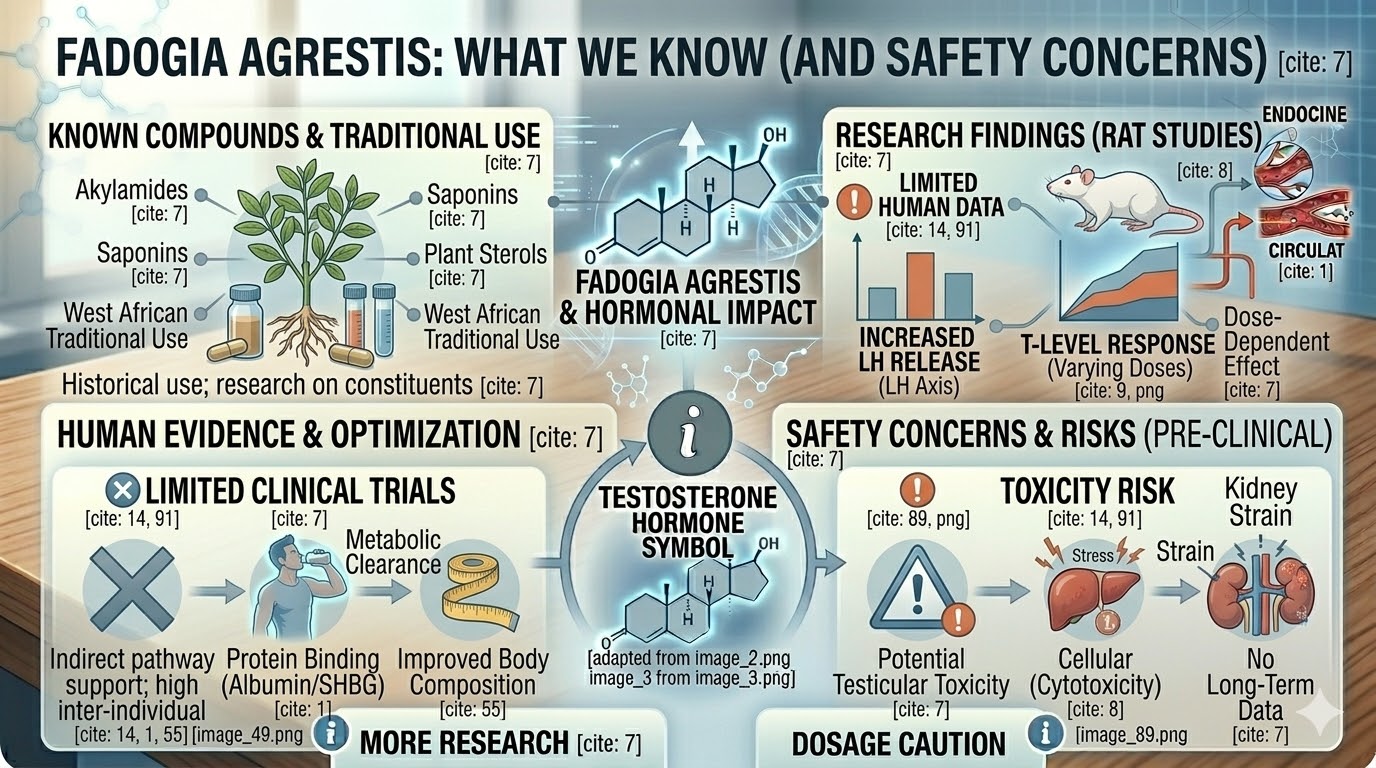
Fadogia agrestis has recently gained attention as a potential natural testosterone booster.
It is often discussed alongside ingredients like tongkat ali and ashwagandha, particularly in fitness and performance communities.
However, unlike more established supplements, fadogia agrestis comes with significant uncertainty, especially regarding safety.
In this guide, we break down:
- what fadogia agrestis is
- what research suggests
- potential risks and safety concerns
- whether it should be considered
What Is Fadogia Agrestis?
Fadogia agrestis is a plant native to parts of Africa and has been used in traditional medicine.
It has been promoted for:
- libido enhancement
- vitality and energy
- testosterone support
However, modern scientific research is limited.
Does Fadogia Agrestis Increase Testosterone?
Some studies — primarily in animals — suggest that fadogia agrestis may increase testosterone levels.
Proposed mechanisms include:
- stimulating hormone signaling
- influencing testicular function
However, there is a critical limitation:
There is very little human research available.
This makes it difficult to determine:
- real-world effectiveness
- appropriate dosing
- long-term safety
Animal Research vs Human Evidence
Most of the claims surrounding fadogia agrestis come from animal studies.
While these studies showed increases in testosterone, they also raised concerns:
- potential toxicity at higher doses
- changes in organ function
Without human studies, these findings cannot be safely translated into recommendations.
For comparison, more established ingredients like tongkat ali have stronger human data: Tongkat Ali for Testosterone
Safety Concerns
This is where fadogia agrestis differs significantly from other supplements.
Key concerns include:
- lack of human safety data
- potential toxicity suggested in animal studies
- unknown long-term effects
Because of this, fadogia agrestis is often categorized as a high-risk, low-evidence ingredient.
For broader context: Testosterone Booster Side Effects: What to Watch For
Why It Became Popular
Fadogia agrestis gained popularity due to:
- social media discussions
- anecdotal reports
- association with performance-focused supplement stacks
However, popularity does not equal safety or effectiveness.
Should You Take Fadogia Agrestis?
Given the current evidence, fadogia agrestis should be approached with caution.
It may not be the best option for individuals seeking safe, reliable testosterone support.
Safer alternatives with more evidence include:
- zinc
- vitamin D
- magnesium
- ashwagandha
- tongkat ali
Explore these: Best Natural Testosterone Booster Ingredients (Evidence Tiers)
The Bigger Picture: Testosterone Optimization
Supplements alone cannot replace foundational habits.
Testosterone is strongly influenced by:
- sleep quality
- stress levels
- body composition
- training
For example: Sleep and Testosterone and Body Fat and Testosterone
Final Thoughts
Fadogia agrestis is one of the most talked-about ingredients in testosterone supplementation — but also one of the least understood.
While early research suggests potential hormonal effects, the lack of human studies and safety concerns make it a high-risk choice.
For most individuals, focusing on:
- proven ingredients
- lifestyle optimization
- evidence-based strategies
is a safer and more effective path to supporting testosterone.
Frequently Asked Questions
Does fadogia agrestis increase testosterone?
Animal studies suggest it may increase testosterone, but there is very limited human evidence.
Is fadogia agrestis safe?
Safety is unclear due to a lack of human studies, and some animal research raises concerns.
Why is fadogia agrestis controversial?
It has gained popularity despite limited research and potential safety risks.
Are there safer alternatives?
Yes. Ingredients like zinc, vitamin D, ashwagandha, and tongkat ali have more evidence and better safety profiles.
Should beginners use fadogia agrestis?
It is generally not recommended due to limited safety data and uncertainty.
Can fadogia agrestis cause liver damage?
Some animal studies have raised concerns about organ toxicity, but human data is insufficient to confirm this risk.
Is fadogia agrestis legal?
Yes, it is legal and available as a dietary supplement, but legality does not guarantee safety.
How long should you take fadogia agrestis?
There are no established guidelines due to lack of research. Cycling or short-term use is sometimes suggested, but safety is unknown.
Does fadogia agrestis affect fertility?
Animal studies suggest possible effects on reproductive organs, but implications for human fertility are unclear.
Can fadogia agrestis be stacked with other supplements?
Stacking is common in fitness communities, but this increases risk and uncertainty due to unknown interactions.
Related Articles
- Testosterone Boosters Explained
- Best Natural Testosterone Booster Ingredients
- Tongkat Ali for Testosterone
- Testosterone Booster Side Effects
- Best Testosterone Boosters: Reviews, Ingredients, and Buyer’s Guide
Explore the Complete Testosterone Health Hub
Learn which testosterone strategies are backed by real science—and how to safely support hormone health without unnecessary risks.
Visit the Testosterone Health Hub →