
Stay Informed With Trusted Health Insights
Join 5,000+ readers who receive evidence-informed health articles, wellness tips, supplement reviews, and practical health guides delivered straight to their inbox.
Get Free Health UpdatesNo spam. Just helpful health education, updates, and resources.
For many people, weight gain does not arrive suddenly.
It arrives quietly—often sometime after age 35.
Calories are tracked. Meals are skipped. Exercise becomes more disciplined.
Yet the scale refuses to move, energy declines, and cravings feel stronger than ever.
If this sounds familiar, you are not alone. This exact pattern is one of the most common frustrations discussed across modern weight loss research, and it is explored in depth throughout our main Weight Loss Hub.
What science now suggests is surprising:
For millions of adults, weight loss failure after 35 is not a discipline problem.
It is a biological communication problem.
When Effort Stops Producing Results
Most people assume that when weight loss stalls, the solution is to “try harder”:
- Eat less
- Exercise more
- Track more aggressively
But many individuals reach a point where increased effort produces diminishing or zero returns.
This pattern is often incorrectly attributed to “slow metabolism,” but emerging evidence shows that metabolism does not simply slow—it becomes misdirected.
Instead of responding to calorie reduction, the body prioritizes fat storage, increases hunger signals, and conserves energy.
This phenomenon is closely linked to metabolic dysfunction, which is explored further in our metabolism-focused cluster under the Weight Loss category.
Weight Loss Is Controlled by Signals, Not Calories
Calories matter—but they are not the command center.
Fat loss is regulated by internal signals that tell the body:
- When it is safe to burn stored fat
- How hungry you should feel
- Whether energy should be conserved or released
When these signals are impaired, the body behaves defensively, regardless of calorie intake.
Think of calories as the message, but metabolic signaling as the delivery system.
If the system is offline, the message never arrives.
The Gut–Metabolism Connection
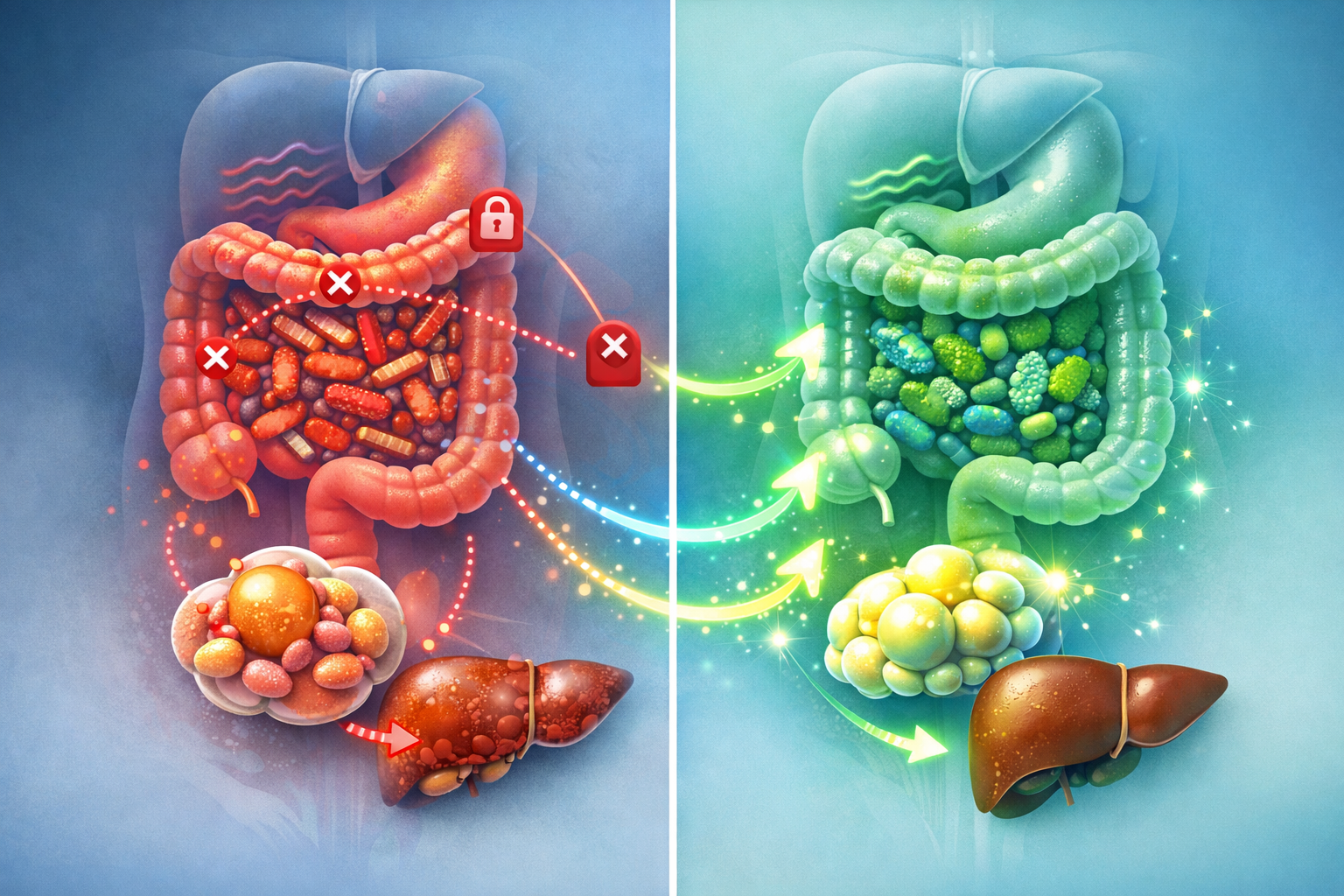
A growing body of research now identifies the gut microbiome as a central regulator of metabolic signaling.
Specific gut bacteria influence:
- Hunger hormones such as ghrelin and leptin
- Inflammation levels that drive fat storage
- Insulin sensitivity and blood sugar regulation
This connection explains why many people struggling with weight also experience symptoms linked to insulin resistance, which is covered in detail here:
https://thehealthknowledgebase.com/blood-sugar/what-is-insulin-resistance/
When gut signaling is disrupted, the body receives constant “store fat” instructions.
Butyrate: The Metabolic Master Switch
One of the most important signaling molecules produced in the gut is butyrate.
Butyrate is a short-chain fatty acid created when beneficial gut bacteria ferment specific fibers. Its role in metabolism is critical:
- It repairs the gut lining, reducing chronic inflammation
- It improves insulin sensitivity
- It sends direct signals to fat cells and the liver to initiate fat burning
Low butyrate levels are strongly associated with:
- Visceral fat accumulation
- Metabolic slowdown
- Persistent cravings
Visceral fat, in particular, is dangerous and difficult to lose once established. We explore this risk further in our planned visceral fat cluster under Weight Loss.
Resistant Starch (RS2): The Missing Nutrient
The question then becomes: what feeds butyrate-producing bacteria?
The answer is resistant starch type 2 (RS2).
Unlike most carbohydrates, RS2:
- Resists digestion in the small intestine
- Reaches the deep colon intact
- Selectively feeds beneficial gut bacteria
Traditional diets once contained far more RS2.
Modern processed diets contain almost none.
This shift has quietly starved the gut bacteria responsible for metabolic signaling.
Clinical Evidence: Fat Loss Without Lifestyle Change
Multiple controlled studies have examined RS2 in isolation.
In double-blind trials where participants were instructed not to change diet or exercise:
- The RS2 group lost significantly more weight than placebo
- Visceral fat was preferentially reduced
- Waist circumference decreased substantially
These findings confirmed that RS2 does not simply reduce calories—it reprograms metabolic behavior.
This explains why some individuals experience fat loss without extreme dieting when gut signaling is restored.
Why Visceral Fat Becomes Stubborn After 40
Visceral fat is metabolically active and closely tied to inflammation and insulin resistance.
When gut signaling is impaired:
- Inflammation rises
- Insulin signaling worsens
- Fat storage becomes the default state
This is why visceral fat often resists calorie-based approaches and why metabolic repair must precede sustainable fat loss.
Metabolic Synergy: Why One Change Is Not Enough
While RS2 is foundational, long-term metabolic dysfunction often requires multiple systems to be supported simultaneously:
- Gut repair
- Inflammation reduction
- Hormonal regulation
- Appetite signaling normalization
This is why addressing only calories or exercise rarely works after 35.
Weight gain at this stage is rarely a single-variable problem—it is systemic.
Why Weight Loss Improvements Go Beyond the Scale
When metabolic signaling improves, many people notice benefits beyond weight:
- Reduced bloating
- More stable energy
- Improved sleep
- Fewer cravings
- Better mood and focus
These improvements highlight a key truth:
Weight gain is often a symptom—not the root cause.
Reframing Weight Loss After 35
If you have been doing “everything right” and still feel stuck, the emerging science offers a powerful reframe:
You are not failing your metabolism.
Your metabolism is missing information.
Restoring the biological signals that regulate fat burning, hunger, and energy may be the most sustainable path forward.
This systems-based approach is the foundation of the strategies explored throughout our
👉 Weight Loss Hub:
https://thehealthknowledgebase.com/weight-loss/
Final Takeaway
Sustainable weight loss after 35 is not about more restriction.
It is about restoring communication.
When the body receives the right signals again, fat loss stops being a fight—and starts becoming a natural biological response.
Explore the Complete Weight Loss Hub
Discover science-backed strategies for sustainable fat loss, metabolism support, hormonal balance, gut health, and long-term weight control — all in one place.

How Trimology Fits Into the Science
As explained in this article, sustainable weight loss after 35 depends on restoring metabolic communication — not forcing the body through extreme restriction. Trimology is designed to support metabolism, appetite regulation, and energy balance in a way that works with your biology rather than against it.
Learn How Trimology Supports Metabolic Balance →
Medically Reviewed for Accuracy
This content has been reviewed for accuracy and clarity by The Health Knowledge Base Medical Review Team, using current research and evidence-based health guidance.
Our review process helps ensure that information related to health, wellness, nutrition, lifestyle strategies, and natural support topics reflects current scientific understanding and responsible editorial standards.
Written by The Health Knowledge Base Editorial Team
Our editorial team consists of health researchers, wellness writers, and content specialists focused on creating clear, practical, and research-informed health content.
We publish educational articles designed to help readers better understand health topics, explore natural wellness strategies, and make more informed lifestyle decisions with confidence.
Affiliate Transparency, Medical Disclaimer & Safety Notice
At The Health Knowledge Base, we take pride in being a trusted resource and affiliate partner with select, high-quality companies. We choose these partnerships carefully because we genuinely believe their products, services, and educational resources align with the values and mission of our website.
When you purchase through certain links on this site, we may receive a small commission or compensation. This helps support our research, content creation, and ongoing work at no additional cost to you. Your price remains exactly the same.
Medical Disclaimer
The information provided by The Health Knowledge Base is for general informational and educational purposes only and is not a substitute for professional medical advice, diagnosis, or treatment.
Always seek the advice of your physician, doctor, or another qualified healthcare provider with any questions you may have regarding a medical condition, symptoms, treatment options, diet changes, exercise programs, or supplements.
Never disregard professional medical advice or delay in seeking it because of something you have read on this website.
Critical Safety Notice
Before making any changes to your diet, starting a new fitness or wellness routine, or taking any supplements mentioned on this site, you should consult with your doctor, physician, or another qualified healthcare professional. Reliance on any information provided by The Health Knowledge Base is solely at your own risk.
View our Affiliate Disclosure → | View our Medical Disclaimer →
Extremely precise and helpful.
Full of clarity, excellent writing.
Howdy! This blog post couldn’t be written any better! Looking through this post reminds me of my previous roommate!
He constantly kept preaching about this. I’ll forward
this article to him. Pretty sure he’s going to have a great read.
I appreciate you for sharing!
Have you ever considered writing an e-book or
guest authoring on other websites? I have a blog centered on the same ideas you discuss and would really like to have
you share some stories/information. I know my readers would appreciate your
work. If you are even remotely interested, feel free to shoot me an e mail.
Much appreciated and thanks. Might be interested!
Very thoughtful writing, thanks!
It is not my first time to visit this web site, i am visiting this site dailly and obtain good data
from here daily.