





Creatine increases phosphocreatine stores in muscle, allowing faster ATP regeneration during short, intense efforts such as sprints and heavy lifts. This lets you do more reps, lift heavier, or sustain high power for longer.[3]
- Benefits: Strength, power, training volume, small but meaningful increases in lean mass when combined with resistance training.[4][3]
- Indirect effect on muscle gain: By letting you train harder, creatine creates a stronger stimulus for hypertrophy over time.[4]
Read more: How Creatine Works
Read more: Creatine and Muscle Growth
What Whey Protein Does (Recovery & Growth)
Whey protein is a fast‑digested, high‑quality protein rich in essential amino acids and BCAAs, especially leucine. It directly stimulates muscle protein synthesis, making it ideal for post‑workout recovery and building muscle.[5]
- Benefits: Supports muscle repair, hypertrophy, and maintenance of lean mass; convenient way to hit daily protein targets.[6][5]
- Direct effect on muscle gain: When total protein intake is adequate, whey consistently enhances strength and fat‑free mass gains during resistance training.[6][5]
Read more: Creatine for Muscle Growth
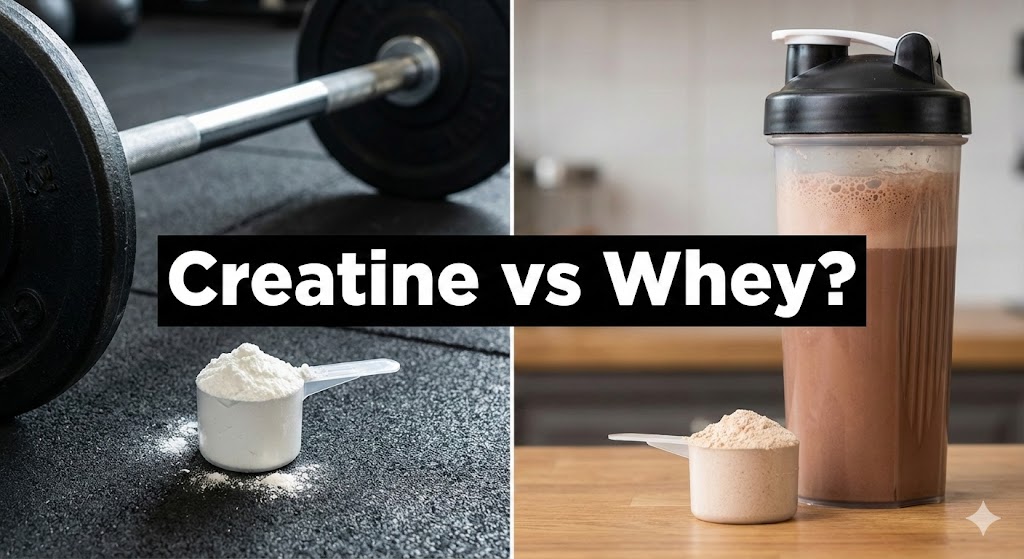
Creatine vs Whey: Which Is “Better”?
There is no universal “better” because they serve different purposes.
- If your protein intake is low: Whey protein is the priority, because without enough total protein, muscle growth is limited no matter how much creatine you take.[5][6]
- If your protein intake is already adequate (roughly 1.6–2.2 g/kg/day): Creatine adds unique performance benefits that protein alone cannot match.[3][4]
For most lifters, using both together gives the best overall results: whey covers recovery and muscle building; creatine amplifies training performance and strength.[7][8][9]
Read more: Is Creatine Safe?
Side‑by‑Side Overview
| Aspect | Creatine | Whey Protein |
|---|---|---|
| Main role | Boosts high‑intensity performance & strength[3] | Provides amino acids for repair & growth[5] |
| Direct muscle building? | Indirect (via harder training)[4] | Direct (stimulates protein synthesis)[6] |
| Best for | Strength, power, explosive sports[3] | Hypertrophy, recovery, hitting daily protein[5] |
| Typical dose | 3–5 g/day[3] | 20–30 g/serving, 1–2×/day[6] |
| Calories | ~0 kcal | ~100–150 kcal per scoop |
| Timing | Flexible; daily consistency matters[3] | Often pre/post‑workout or when short on protein[5] |
| Works together? | Yes, very well[7][9] | Yes, very well[7][9] |
FAQs
1. Should I buy creatine or whey protein first?
If daily protein intake is low, start with whey; if protein is already sufficient, creatine is usually the next best add‑on. Read More[6][5]
2. Can I take creatine and whey protein together in the same shake?
Yes. They do not interfere with each other, and combining them may even improve creatine uptake. Read More[8][9][7]
3. Which builds more muscle: creatine or whey?
Whey directly supports muscle growth by supplying protein; creatine helps indirectly by boosting performance. Both together outperform either alone in some studies. Read More[9][4]
4. Is creatine or whey better for fat loss?
Creatine helps maintain training intensity and lean mass without adding calories; whey can help preserve muscle while dieting by meeting protein needs. Read More[2][1]
5. Do I need creatine if I already use whey?
If your goal is maximum strength and performance, creatine still adds benefits on top of whey. Read More[3][4]
6. Is whey protein necessary if I eat a lot of whole‑food protein?
Not strictly; whey is a convenient way to reach protein targets and time protein around training. Read More[5]
7. Are there side effects from using both?
Both are generally safe for healthy people when used as directed; minor GI discomfort is the most common complaint. Read More[3][5]
8. What’s the best timing for each?
Creatine: anytime daily; whey: often post‑workout or between meals to support total protein intake. Read More[5][3]
9. Can vegetarians and vegans use both?
Yes. Creatine is synthetic, and many whey alternatives (like plant proteins) can be used instead for those avoiding dairy. Read More[10]
10. Which is more budget‑friendly long‑term?
Per serving, creatine is usually cheaper, but they serve different roles; budget decisions should be based on your current diet gaps. Read More[2][10]
Related Articles
- How Creatine Works: A Detailed Explanation
- Creatine for Muscle Growth: How It Works
- Best Creatine Supplements for 2025
Recommendations
- Need performance and recovery? Use both: Shop creatine and whey recommendations.
- Unsure how to dose them together? Read How to Take Creatine: Loading, Cycling & Maintenance.
- New to supplements? Start with Creatine for Beginners: Common Mistakes to Avoid.
Maximize Results with Both
As you’ve learned, creatine and whey work best together. Start with premium Creatine Ultimate CRN-5 for enhanced performance, then add quality protein for complete recovery.

References (for this article’s numbers)
- Candow DG, et al. Effect of creatine supplementation during resistance training on lean tissue mass and strength in older adults. J Nutr Health Aging. 2017.[3]
- Forbes SC, et al. The effects of creatine supplementation combined with resistance training on regional changes in muscle mass: systematic review and meta‑analysis. Nutrients. 2023.[4]
- SciTron. “Creatine vs Whey Protein: Which is Better for Bodybuilding?” 2023.[1]
- Garage Gym Reviews. “Creatine vs Whey: Which Is Better?” 2023.[2]
- Guardian. “What Are the Benefits of Combining Whey Protein and Creatine?” 2022.[7]
- Wellbeing Nutrition. “Taking Protein & Creatine Together? 5 Surprising Effects.” 2025.[8]
- Whey protein supplementation in muscle hypertrophy. Eur J Public Health. 2020.[6]
- Nacpro. “Creatine vs Whey Protein: Which is best for muscle building?” 2025.[10]