






Testosterone boosters are among the most widely marketed supplements in men’s health. They are often promoted as solutions for low energy, reduced libido, muscle loss, and declining performance.
However, the term “testosterone booster” is frequently misunderstood.
Some products support hormone health indirectly, while others are marketed with claims that are not fully supported by scientific evidence.
In this guide, we explain:
- what testosterone boosters actually are
- how they work (and how they don’t)
- which ingredients have evidence behind them
- what to realistically expect
What Are Testosterone Boosters?
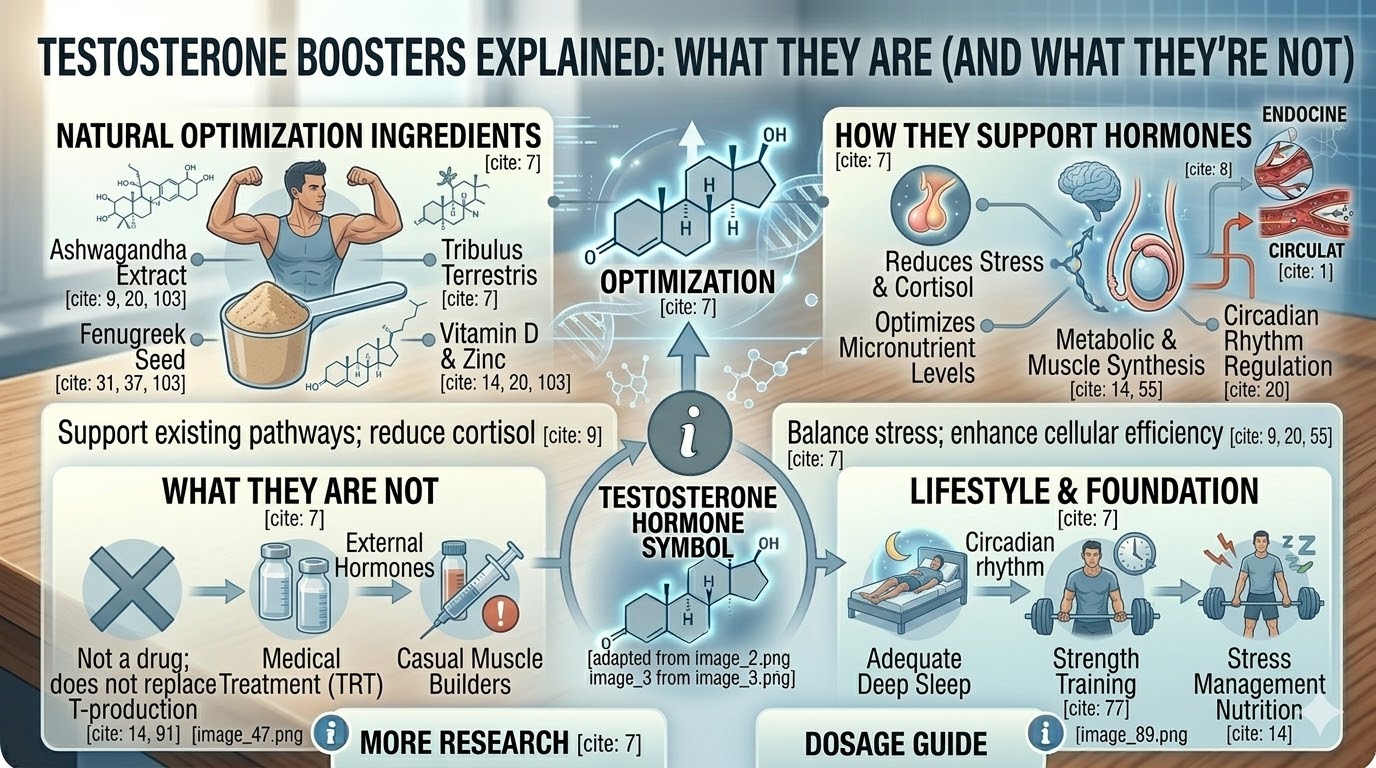
Testosterone boosters are dietary supplements designed to support the body’s natural testosterone production.
They typically contain a combination of:
- vitamins and minerals
- herbal extracts
- amino acids
- plant compounds
Unlike medical therapies such as testosterone replacement therapy (TRT), these supplements do not contain testosterone itself.
Instead, they aim to support the body’s natural hormone regulation systems.
If you’re new to hormone health, it helps to understand the basics: What Is Testosterone? Functions, Levels, and Why It Matters
What Testosterone Boosters Are NOT
Understanding the limitations of these supplements is essential.
Testosterone boosters:
- do NOT act like anabolic steroids
- do NOT replace testosterone in the body
- do NOT produce rapid or dramatic hormonal changes
Their effects, when present, are typically:
- gradual
- dependent on lifestyle factors
- influenced by baseline health
How Testosterone Boosters Work
Most testosterone boosters work by targeting key biological systems that influence hormone production.
1. Supporting Nutrient Deficiencies
Certain nutrients are essential for testosterone production.
For example:
- zinc
- magnesium
- vitamin D
If a person is deficient in these nutrients, correcting that deficiency may help support normal testosterone levels.
This is explained in more detail here: Zinc, Magnesium, and Vitamin D for Testosterone: What Actually Helps
2. Reducing Stress and Cortisol
Chronic stress is one of the most common factors that suppress testosterone.
Elevated cortisol can interfere with hormone signaling and reduce testosterone production.
Some ingredients in testosterone boosters aim to help regulate stress.
Learn more about this relationship: High Stress and Cortisol: How They Suppress Testosterone
3. Supporting Sleep and Recovery
Sleep plays a critical role in testosterone production.
Most testosterone is released during deep sleep stages, making sleep quality one of the most important factors in hormone health.
Some supplements may indirectly support sleep or recovery.
You can explore this further here: Sleep and Testosterone: How Deep Sleep Drives Hormone Production
4. Improving Body Composition
Excess body fat is associated with lower testosterone levels due to hormonal interactions.
Some ingredients aim to support metabolism or fat loss, which may indirectly benefit testosterone levels.
This relationship is explained here: Body Fat and Testosterone: Why Belly Fat Lowers T
Do Testosterone Boosters Actually Work?
The effectiveness of testosterone boosters depends heavily on individual factors such as:
- baseline hormone levels
- nutrient status
- sleep quality
- training habits
- overall metabolic health
In men with deficiencies or poor lifestyle habits, certain ingredients may help support normal testosterone levels.
However, for individuals who already have optimized sleep, nutrition, and training, the effects are often modest.
Evidence-Based vs Marketing Claims
Not all testosterone boosters are created equal.
Some ingredients have moderate scientific support, while others rely more on traditional use or limited research.
We break down the strongest ingredients and their evidence levels here: Best Natural Testosterone Booster Ingredients (Evidence Tiers)
Common Ingredients Found in Testosterone Boosters
Many supplements include combinations of the following:
- ashwagandha
- tongkat ali
- fenugreek
- D-aspartic acid
- zinc and magnesium
- vitamin D
Each ingredient has different mechanisms and levels of scientific support.
Who May Benefit From Testosterone Boosters?
Testosterone boosters may be more relevant for individuals who:
- have nutrient deficiencies
- experience chronic stress
- have poor sleep habits
- are recovering from overtraining
- are experiencing age-related hormone decline
However, they are not a substitute for medical treatment when testosterone levels are clinically low.
For a full breakdown of symptoms and causes: What Causes Low Testosterone? The Most Common Hidden Drivers
Safety Considerations
Most natural testosterone boosters are generally well tolerated when used appropriately.
However:
- ingredient quality varies
- dosages may differ between products
- some compounds may interact with medications
Understanding potential risks is important before using any supplement.
See: Testosterone Booster Side Effects: What to Watch For
Final Thoughts
Testosterone boosters can support hormone health in specific situations, particularly when lifestyle factors or nutrient deficiencies are present.
However, they are not a shortcut or replacement for foundational habits such as:
- consistent sleep
- balanced nutrition
- resistance training
- stress management
When used correctly, they may complement a healthy lifestyle — but they should not replace it.
Frequently Asked Questions
Do testosterone boosters actually increase testosterone?
Some ingredients may support testosterone levels, especially in individuals with deficiencies or poor lifestyle habits. Effects are typically modest and gradual.
Are testosterone boosters safe?
Most natural supplements are safe when used appropriately, but product quality and ingredient combinations vary.
How long do testosterone boosters take to work?
Results, if present, usually occur over several weeks and depend on overall health and lifestyle.
Can testosterone boosters replace TRT?
No. Testosterone boosters are not a substitute for medical treatment in individuals with clinically low testosterone.
Who should consider testosterone boosters?
Individuals with poor sleep, high stress, nutrient deficiencies, or age-related decline may benefit the most.
Do I need a prescription for testosterone boosters?
No, testosterone boosters are over-the-counter supplements. However, consulting a healthcare provider before use is recommended.
Can testosterone boosters cause side effects?
Some individuals may experience mild side effects such as digestive discomfort, headaches, or changes in mood, depending on ingredients.
Are testosterone boosters FDA approved?
Dietary supplements are not FDA approved in the same way medications are. Quality and safety depend on the manufacturer.
Should younger men take testosterone boosters?
Most younger men with healthy testosterone levels do not need testosterone boosters. Lifestyle habits are usually the more important focus.
Can women take testosterone boosters?
Some products may be formulated for women, but most are designed specifically for men. Women should consult a healthcare provider before use.
Related Articles
- Best Natural Testosterone Booster Ingredients (Evidence Tiers)
- Ashwagandha and Testosterone
- Tongkat Ali for Testosterone
- Testosterone Booster Side Effects
- Best Testosterone Boosters: Reviews, Ingredients, and Buyer’s Guide
Explore the Complete Testosterone Health Hub
Learn how lifestyle, nutrition, and evidence-based strategies support testosterone health and long-term performance.
Visit the Testosterone Health Hub →